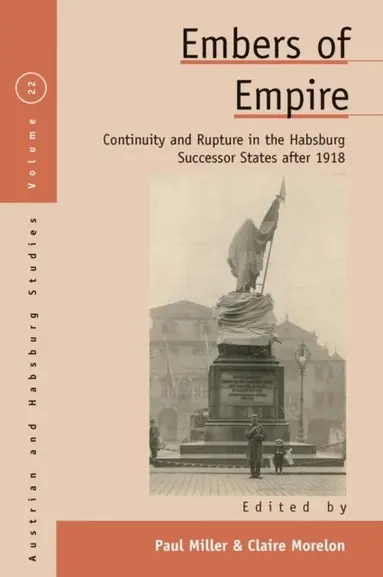
Embers of Empire
Continuity and Rupture in the Habsburg Successor States after 1918
2 171 kr
Beställningsvara. Skickas inom 7-10 vardagar. Fri frakt över 249 kr.
Fler format och utgåvor
Beskrivning
Produktinformation
- Utgivningsdatum:2018-11-29
- Mått:152 x 229 x 23 mm
- Vikt:602 g
- Format:Inbunden
- Språk:Engelska
- Serie:Austrian and Habsburg Studies
- Antal sidor:366
- Förlag:Berghahn Books
- ISBN:9781789200225
Utforska kategorier
Mer om författaren
Paul Miller teaches history at the John Paul II Catholic University of Lublin (Poland) and at McDaniel College in the U.S. His forthcoming book, Misfire: The Sarajevo Assassination and the Winding Road to World War I, will be published by Oxford University Press in February 2022.
Recensioner i media
“Taken together this set of essays provides an exciting overview of current work in the field and sets an agenda for further research on this crucial period in Central and East Central European history. This is a valuable, impressive collection, and the editors must be complimented on their achievement.” • German History“As a whole, this book succeeds in complicating our views of the postimperial transition… This book gives us an able starting point on which to build new scholarship and continue conversations with one another that enliven and enrich our understanding of a complicated and difficult past.” • H-Net (Habsburg)“Overall, this is an excellent text with a lot of interesting and novel observations on the experiences of people in the successor states of the AustroHungarian Empire. Our tendency in the past has been to wall off our studies along contemporary national boundaries, and the editors of this book have illustrated how these new nation- states both related to one another and struggled to create independent identities. Scholars of the late years of the empire and the transitions aft er its dissolution will undoubtedly find it a valuable resource, and I would not limit my recommendation just to historians. Anyone who studies Central European culture in the first half of the twentieth century may find something useful in this book.” • Journal of Austrian Studies“Recently, another research trend can be observed: a revitalization of regional history. This has also brought new perspectives to the Habsburg monarchy and its neighbours and its successor states…This volume takes up these research trends... and makes an important contribution. The title "Embers of the Empire" can be taken literally. From the embers of empires, the successor states were able to strike new political sparks; under the surface of the new democratic orders, however, conflicts continue to swell… The study of the common history of empires and nation states, not least in their regional shades, offers many points of reference for further research.” • Bohemia “In his afterword, Pieter Judson reminds us of the still dominant ideal of nations and nation states especially after 1918. As this ambitious and, all in all, very successful volume shows, however, new approaches in the study of history will offer new perspectives on the intricate afterlife of the Habsburg Empire.” • Hungarian Historical Review“The major strengths of the work are informed, updated, and ambitious pieces that attempt to span the range of the empire in the style of the ‘Kronprinzenwerk’. Embers of Empire thus represents a sound start for further research, especially on the biographies of less well-known personalities that appeared on the stage in the wobbly world of the post-bellum states. For these reasons, it should find its place in every Habsburg and Central European historian’s shelf.” • Vicko Marelić in Contemporary Austrian Studies“Embers of Empire is a highly impressive, thoroughly researched, and very well-written collection that draws on sources from multiple archives across all of the languages of the successor states. It will be of great interest to historians of Europe and Habsburg scholars, as well as specialists focusing on Eastern Europe and the Balkans.” • Günter Bischof, University of New Orleans“The brilliant and well-informed essays in this collection insightfully deal with continuities between the late Habsburg and post-Habsburg eras. It exemplifies the recent stream of scholarship that has significantly revised the history of the Habsburg Empire and its legacies.” • Rudolf Kučera, Masaryk Institute and Archives of the Czech Academy of Sciences
Innehållsförteckning
- List of IllustrationsAcknowledgmentsIntroductionClaire MorelonPART I: PERMANENCE AND REVOLUTION: NATIONAL POLITICS IN THE TRANSITION TO THE SUCCESSOR STATESChapter 1. Negotiating Post-Imperial Transitions: Local Societies and Nationalizing States in East Central Europe Gábor EgryChapter 2. State Legitimacy and Continuity between the Habsburg Empire and Czechoslovakia: The 1918 Transition in Prague Claire MorelonChapter 3. Strangers among Friends: Leon Biliński between Imperial Austria and New Poland Iryna VushkoChapter 4. Ideology on Display: Continuity and Rupture at Exhibitions in Austria-Hungary and Czechoslovakia, 1873–1928 Marta FilipováPART II: THE HABSBURG ARMY'S FINAL BATTLESChapter 5. Reflections on the Legacy of the Imperial and Royal Army in the Successor States Richard BassettChapter 6. Imperial into National Officers: K.(u.) K. Officers of Romanian Nationality Before and after the Great War Irina MarinChapter 7. Shades of Empire: Austro-Hungarian Officers, Frankists, and the Afterlives of Austria-Hungary in Croatia, 1918–1929 John Paul NewmanPART III: CHURCH, DYNASTY, ARISTOCRACY: THE POST-WAR FATE OF IMPERIAL PILLARSChapter 8. “All the German Princes Driven Out!”: The Catholic Church in Vienna and the First Austrian Republic Michael Carter-SinclairChapter 9. Wealthy Landowners or Weak Remnants of the Imperial Past?: Central European Nobles during and after the First World War Konstantinos RaptisChapter 10. Sinner, Saint―or Cipher?: The Austrian Republic and the Death of Emperor Karl I Christopher BrennanPART IV: HISTORY, MEMORY, MENTALITÉ: PROCESSING THE EMPIRE'S PASSINGChapter 11. “What Did They Die For?”: War Remembrance in Austria in the Transition from Empire to Nation State Christoph MickChapter 12. “The First Victim of the First World War”: Franz Ferdinand in Austrian Memory Paul MillerAfterwordPieter M. JudsonIndex
Mer från samma författare
Mental Health Case Studies in Paramedic Practice
Joanne Augustus, Yuet Wah Patrick, Paula Gardner, Paul Miller
Häftad, 2026
334 kr
Handbook of the Economics of International Migration
Barry Chiswick, Paul Miller
Inbunden, 2014
2 301 kr
Mer från samma serie
Territorial Revisionism and the Allies of Germany in the Second World War
Marina Cattaruzza, Stefan Dyroff, Dieter Langewiesche
Inbunden, 2012
1 936 kr
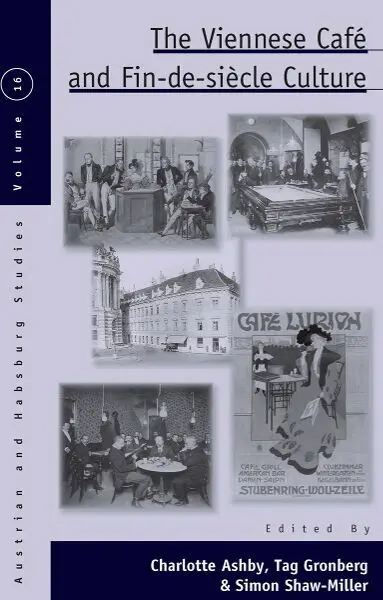
The Viennese Café and Fin-de-Siècle Culture
Charlotte Ashby, Tag Gronberg, Simon Shaw-Miller
Inbunden, 2013
1 965 kr
Austrian Women in the Nineteenth and Twentieth Centuries
David F. Good, Margarete Grandner, Mary Jo Maynes
Häftad, 1996
526 kr
Austrian Women in the Nineteenth and Twentieth Centuries
David F. Good, Margarete Grandner, Mary Jo Maynes
Inbunden, 1996
1 936 kr