- -15% på allt
Persistent Inequalities
Wage Disparity under Capitalist Competition
361 kr
Beställningsvara. Skickas inom 7-10 vardagar. Fri frakt över 249 kr.
Beskrivning
Produktinformation
- Utgivningsdatum:2018-12-11
- Mått:155 x 230 x 19 mm
- Vikt:532 g
- Format:Häftad
- Språk:Engelska
- Antal sidor:375
- Förlag:Haymarket Books
- ISBN:9781608460199
Utforska kategorier
Mer om författaren
Howard Botwinick, Ph.D. (1985) New School for Social Research, is Associate Professor of Economics at SUNY Cortland. He has been active in several unions and was a founding member of the U.S. Labor Party in the 1990s.
Recensioner i media
“Persistent Inequalities makes a major contribution to economic theory, bringing together a number of existing analytical elements and forging them into a coherent, logical analysis. Further, it includes important innovations. The analytical strength of the book lies in its use of competition as the explanatory mechanism for wage differential […] It offers an exciting and stimulating explanation of a real-world phenomenon and its social implications.” —John Weeks, University of London, Center for Development Studies, School of Oriental and African Studies“Today employers cite ‘competitiveness’ as the reason for cutting wages and benefits and imposing new forms of speed-up. Good jobs are replaced by technology, on the one hand, and subcontracted, substandard jobs, on the other, as capital rushes to cut labor costs. The result is both a general decline in U.S. real wages, now below their 1973 level, and greater inequalities among workers. Persistent Inequalities gives us a contemporary Marxist analysis of wage and income differentials in the labor force – one that is based on the actual dynamics of capitalist competition. Because of this, economist Howard Botwinick, particularly in his conception of the ‘regulating capital,’ has given us a prism through which to craft strategies to end the very decline and inequality he explains.”—Kim Moody, author of An Injury to All: The Decline of American Unionism and US Labor in Trouble and Transition“Botwinick’s scholarship is first-rate. His main objective is to reconstruct the explanation for interindustry and intraindustry wage differentials on the basis of the perspective of classical political economy and classical Marxism, rather than orthodox (neoclassical) economics. An important thrust of the book is the argument that the orthodox perspective, particularly in its human capital variant, fails to explain not only differences in earnings across occupations but also differences between persons who may differ ascriptively by race or by gender. The failure is due to the orthodox theory’s invalid characterization of competition. The author demonstrates that the classical perspective can be utilized to provide a much richer and persuasive theory of wage differences […] This work is certainly a significant contribution both to the theory of income distribution and to the theory of industrial organization in economics. In addition, the author explains difficult technical issues in an accessible fashion.”—William, Darity, Jr, University of North Carolina “Labor organizer turned economist, Howard Botwinick, has written a seminal book in labor economics. Drawing upon the theoretical work of his teacher, Anwar Shaikh of the New School for Social Research, Botwinick in Persistent Inequalities has built what has eluded radical economists, namely, a fully determinate model of labor markets […] The beauty of Botwinick’s analysis is that, while class struggle enters into wage determination, wage rates are not completely indeterminate. There are concrete limits to wage increases […] Botwinick’s work has important implications for the labor movement. At any given time, there will be excellent organizing opportunities. Many of our service industries today are likely to be regulating capitals, and, therefore, good targets for unionization […] So are low-wage workers in highly capitalized industries […]”—Michael Yates, author of Why Unions Matter, in Monthly Review, February 1996

Innehållsförteckning
- New Preface (2017 Edition)Preface and Acknowledgements (1993 Edition)List of FiguresList of Tables1 IntroductionBreaking the ImpasseToward a Theoretical AlternativeImplications for the Analysis of DiscriminationOn Heterogeneous LabourComparing Our Results to Orthodox and Radical EconomicsSolving Some AnomaliesOutline of the Argument2 Continuing Attempts to Square the Circle (Or, Competitive Theory Confronts Differential Wage Rates)Early Neoclassical Wage TheoryThe Theory of Perfect Competition: Abstraction as IdealisationThe Inevitable Schism between Theory and PracticeThe Theory of Imperfect Competition – Godsend or Albatross?Postwar Institutionalists: An Initial Attempt at Alternative TheoryThe Ascent of Human Capital TheoryThe Real World Strikes BackThe New Institutionalists: The Dual Economy and Dual Labour MarketsLabour Market Segmentation and Monopoly CapitalThe Initial Response to Segmentation TheoryThe Second Wave of Segmentation ArgumentsThe Continuing Search for a Radical AlternativeEfficiency Wage Theory: The Latest Attempt to Square the Circle3 Capitalist Accumulation and the Aggregate Labour MarketMarx versus Neoclassical EconomicsThe Special Commodity Labour PowerPrimitive Accumulation and the ‘Doubly Free’ LabourerThe Unique Logic of Labour SupplyCapitalist Accumulation and the Reserve Army of LabourMarx’s Reserve Army within the Modern PeriodOn the Necessity of Worker ResistanceCapitalist Accumulation and the Limits to Rising Wage RatesEmpirical Evidence for Limits to Rising Wage Rates4 Wage Differentials and the Aggregate Labour MarketCapitalism’s Active and Reserve Armies: Differentiation and ‘Segmentation’ in Their Most Basic FormsThe Role of Workers in the Segmentation ProcessA Dynamic Analysis of Labour Mobility and Wage Differentiation Under Conditions of Permanent UnderemploymentUneven Technical Change, Competition, and the Reserve Army: A Brief Glimpse of Marx’s Theory of Wage DifferentialsOn the Incompleteness of Marx’s Work5 Capitalist Competition and Differential Profit RatesCompetition within IndustriesCompetition between IndustriesMarx’s Concept of Regulating CapitalsEmpirical Evidence of MonopolyChapter SummaryAppendix to Chapter 56 Capitalist Competition and Differential Wage Rates (I): The Analysis of Regulating CapitalsOverview of the Dynamic Adjustment to Changing Wage RatesDeriving Determinate Limits to Rising Wage RatesLimit One: The Immediate Profitability of Regulating CapitalsLimit Two: The Unit Costs of Subdominant CapitalsFurther Implications for Inter- and Intraindustry Wage PatternsLimit Three: The Differential Costs of Obstructing Wage IncreasesAnalysing the Effects of Uneven Worker OrganisationA Final Note on Workers’ Power and the Costs of ObstructionThe General Laws of Capitalist Accumulation7 Capitalist Competition and Differential Wage Rates (II): Non-regulating Capitals and Differential Profit RatesThe Case of Less Efficient CapitalsShort-Term Effects of Rising Wage RatesThe Case of More Efficient CapitalsImplications of the Dynamic Equalisation of Profit RatesConclusionCapitalist Competition and Differential Wage Rates: Abundant Possibilities for Sustained InequalityCapitalist Accumulation and the Aggregate Labour Market: Further Sources of Wage VariationComparing Our Results to Neoclassical EconomicsComparing Our Results to Radical EconomicsImplications for Empirical ResearchImplications for the Contemporary Labour MovementAfterword: The Past 20 Years Have Not Been PrettyWhere Do We Go from Here? Lessons from the 1930sBut Hasn’t Accelerated Globalisation Made the Old CIO Strategies Obsolete?Given the Dismal State of the Left, How Can We Get There from Here? A Final Lesson from the 1930sReferencesIndex
Du kanske också är intresserad av
- -15% på allt
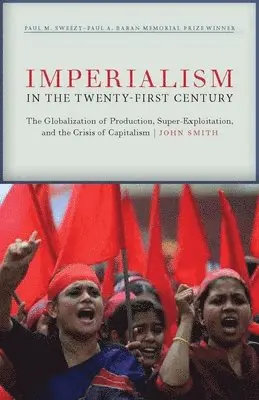
Imperialism in the Twenty-First Century
John Smith
Häftad, 2016
250 kr
From Value to Uneven Development
John Weeks, Ben Fine, Simon Mohun, Alfredo Saad-Filho
Häftad, 2025
374 kr

- -19%