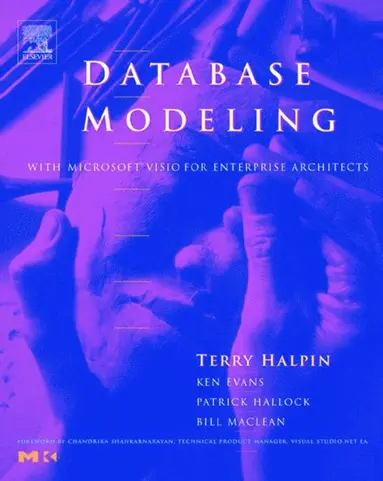
Database Modeling with Microsoft� Visio for Enterprise Architects
1 223 kr
Beställningsvara. Skickas inom 7-10 vardagar. Fri frakt över 249 kr.
Beskrivning
�Explains how to model databases with Microsoft� Visio for Enterprise Architects (VEA), focusing on tool features.�Provides a platform-independent introduction to data modeling using both Object Role Modeling (ORM) and Entity Relationship Modeling (ERM), and includes practical advice on managing database projects.�Additional ORM models, course notes, and add-ins available online.
Produktinformation
- Utgivningsdatum:2003-09-11
- Mått:187 x 235 x 18 mm
- Vikt:730 g
- Format:Häftad
- Språk:Engelska
- Serie:The Morgan Kaufmann Series in Data Management Systems
- Antal sidor:425
- Förlag:Elsevier Science
- ISBN:9781558609198
Utforska kategorier
Mer om författaren
Dr. Terry Halpin, is a Principal Scientist at LogicBlox, headquartered in Atlanta, USA, and a Professor at INTI International University, Malaysia. After many years in academia, he worked on data modeling technology at Asymetrix Corporation, InfoModelers Inc., Visio Corporation, and Microsoft Corporation, before returning to academia as Distinguished Professor at Neumont University (Utah, USA), and then once again returning to industry at LogicBlox and also taking a professorship at INTI. His research focuses on conceptual modeling and conceptual query technology. Dr. Halpin is the recipient of the DAMA International Academic Achievement Award and the IFIP Outstanding Service Award. He is a member of IFIP WG 8.1 (Design and Evaluation of Information Systems), is an editor or reviewer for several academic journals and international program committees, has co-chaired several international workshops on modeling, and has presented at dozens of international conferences in both industry and academia. For many years, his research has focused on conceptual modeling and conceptual query technology for information systems, using a business rules approach. His doctoral thesis formalized Object-Role Modeling (ORM/NIAM), and his publications include over 160 technical papers, and six books, including Information Modeling and Relational Databases, Second Edition, Elsevier/Morgan Kaufmann. Ken Evans has taught and applied ORM in English and French for 10 years. His know-how in data and process modeling and complex systems management comes from over 30 years in industry, including international jobs with IBM, EDS, Honeywell Controls, and Plessy and clients among the Fortune 500. Patrick Hallock, M.S., is the founder of InConcept, a consulting firm, and teaches object modeling throughout the United States. He has been in the industry for 30 years, focusing on database design, with an emphasis on ORM. Bill MacLean, CPA, is an independent consultant and teacher who has worked with relational databases for over 15 years, and consulted in database design for the last 9. He believes that the purpose of a data model is to turn business requirements into buildable specifications.
Innehållsförteckning
- Foreword Preface Part 1 Overview of Database Modeling and the Database Modeling Tool 1 Introduction 1.1 Why Read This Book? 1.2 What Can You Do with Visio for Enterprise Architects? 1.3 What Can You Do with the Database Modeling Solution? 1.4 How Can You Best Use This Book? 1.5 Format Conventions 2 Database Modeling 2.1 Four Information Levels 2.2 Designing Databases at the Logical level 2.3 Designing Databases at the Conceptual Level 2.4 The Database Life Cycle 3 Getting Started 3.1 Product Editions and Versions 3.2 Installation 3.3 The Visio Interface 3.4 Using Help 3.5 Pagination and Layers 3.6 Simple Examples of Forward Engineering Part 2 The Conceptual Modeling Solution (ORM) 4 Object Types, Predicates, and Basic Constraints 4.1 Object Types 4.2 Fact Types 4.3 Adding Basic Constraints in the Fact Editor 4.4 Populating Fact Types with Examples 4.5 Saving a Model 4.6 Verbalization and Hyphenation 4.7 Objectifying an Association (Nesting) 4.8 Model Error Checks 4.9 Derived Fact Types 4.10 Data Types 5 ORM Constraints 5.1 Value Constraints 5.2 Internal and External Uniqueness Constraints 5.3 Simple and Disjunctive Mandatory Constraints 5.4 Constraint Editing and Deletion 5.5 Set-Comparison Constraints 5.6 Subtyping 5.7 Frequency Constraints 5.8 Ring Constraints 5.9 Indexes 5.10 Constraint Layers 6 Configuring, Manipulating, and Reusing ORM Models 6.1 Configuring ORM Preferences 6.2 Showing Relationships for Object Types 6.3 Redisplaying Model Elements 6.4 Cloning Model Elements 6.5 Cutting and Pasting Model Elements 6.6 Referencing Model Elements 7 Mapping ORM Models to Logical Database Models 7.1 Forward Engineering ORM Source Models 7.2 Refining the Logical Model 7.3 Migrating Changes back to ORM Source Models 7.4 Controlling Logical Name Generation 7.5 Constraint Code 7.6 Subtype Mapping 8 Reverse Engineering and Importing to ORM 8.1 Reverse Engineering to ORM 8.2 Displaying the ORM Model Graphically 8.3 Refining the ORM Schema 8.4 Importing VisioModeler and ERX Files 9 Conceptual Model Reports 9.1 Conceptual Model Reports—Overview 9.2 Object Type Reports 9.3 Constraint Type Reports 9.4 Fact Type Reports 9.5 Supertype Reports 9.6 Copying Diagrams and Text Part 3 The Logical Modeling Solution (ER and Relational) 10 Creating a Basic Logical Database Model 10.1 The Database Model Diagram Solution 10.2 Notation Options 10.3 Creating a Database Model Diagram 10.4 Adding Attributes to an Entity 10.5 Adding Basic Constraints 10.6 Basic Model Housekeeping 10.7 Projects and ER Source Models 11 Generating a Physical Database Schema 11.1 Physical Schemas and Database Drivers 11.2 Creating a Basic DDL Script 11.3 Database Driver Options 11.4 Generating Schemas via an ODBC Connection 11.5 The ODBC Driver Setup Pane 12 Editing Logical Models: Intermediate Aspects 12.1 The Database Properties Dialog 12.2 Table Properties 12.3 Column Properties 12.4 Foreign Key Relationships 12.5 Category Relationships 12.6 Show Related Tables 12.7 Views 12.8 Pagination 12.9 Verbalization 12.10 Model Error Check 12.11 Driver, Document, and Modeling Options 13 Editing Logical Models: Advanced Aspects 13.1 Copying Model Elements 13.2 Cloning Model Elements 13.3 Database Properties: Definition and Notes 13.4 Check Clauses 13.5 Indexes 13.6 Triggers 13.7 Stored Procedures 13.8 Raw DDL 13.9 User Defined Functions 13.10 User Defined Types 13.11 Extended Properties 13.12 The Object-Relational Stencil 14 Reverse Engineering Physical Schemas to Logical Models 14.1 Using the Reverse Engineer Wizard 14.2 Reviewing the Result 14.3 Handling Errors and Warnings 14.4 Other Reverse Engineering Options 15 Logical Database Model Reports 15.1 New Report Wizard 15.2 Statistical Report 15.3 Table Report 15.4 Data Types Report Part 4 Managing Database Projects 16 Change Propagation and Round-Trip Engineering 16.1 Overview of Change Propagation 16.2 Mapping ORM Changes to Logical Models 16.3 Migrating Logical Model Changes to ORM Models 16.4 Updating Physical Schemas with Logical Model Changes 16.5 Refreshing Logical Models with Physical Schema Changes 16.6 Three-Way Synchronization 16.7 Code Synchronization and Transfer 16.8 Data Migration 16.9 DDL Script vs. Automated Update 17 Other Features and Best Practices 17.1 Model Reviews and Presentations 17.2 Librarianship 17.3 Distributing Your Database Models Glossary and ORM Notation Further Resources Index
Mer från samma författare
Database Modeling with Microsoft(R) Visio for Enterprise Architects
Bill Maclean, Pat Hallock, Ken Evans, Terry Halpin
906 kr
Database Design: Know It All
Jim Melton, Sam S. Lightstone, W.H. Inmon, Jan L. Harrington, Terry Halpin, Ralf Hartmut Guting, Lowell Fryman, Stephen Buxton, Graham Witt, Graeme Simsion, Markus Schneider, Patrick O'Neil, Elizabeth O'Neil, Bonnie O'Neil, Thomas P. Nadeau, Tony Morgan, Toby J. Teorey
839 kr
Database Design: Know It All
Toby J. Teorey, Tony Morgan, Thomas P. Nadeau, Bonnie O'Neil, Elizabeth O'Neil, Patrick O'Neil, Markus Schneider, Graeme Simsion, Graham Witt, Stephen Buxton, Lowell Fryman, Ralf Hartmut G�ting, Terry Halpin, Jan L. Harrington, W.H. Inmon, Sam S. Lightstone, Jim Melton
Inbunden, 2008
782 kr
Mer från samma serie
Java Data Mining: Strategy, Standard, and Practice
Mark F. Hornick, Erik Marcadé, Sunil Venkayala
Häftad, 2006
628 kr
Du kanske också är intresserad av
Database Modeling with Microsoft(R) Visio for Enterprise Architects
Bill Maclean, Pat Hallock, Ken Evans, Terry Halpin
906 kr
Information Modeling Methods and Methodologies: Advanced Topics in Database Research
Keng Siau, Terry Halpin, John Krogstie
978 kr
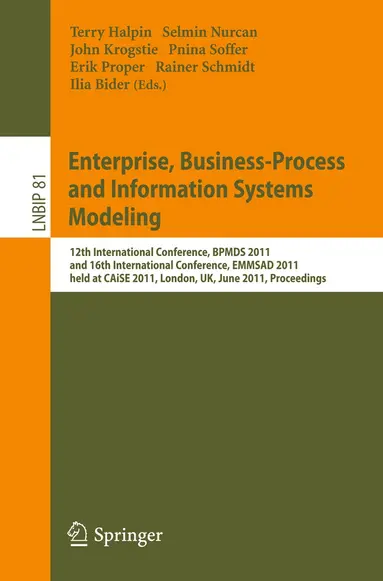
Enterprise, Business-Process and Information Systems Modeling
Terry Halpin, Selmin Nurcan, John Krogstie, Pnina Soffer, Erik Proper, Rainer Schmidt, Ilia Bider
Häftad, 2011
569 kr
Enterprise, Business-Process and Information Systems Modeling
Roland Ukor, Pnina Soffer, Rainer Schmidt, Erik Proper, Selmin Nurcan, John Krogstie, Terry Halpin
739 kr
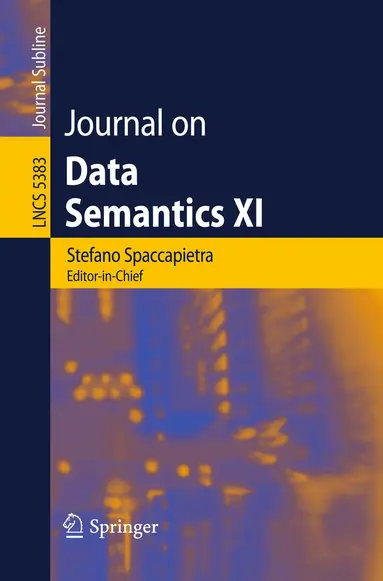
Journal on Data Semantics XI
Jeff Z. Pan, Philippe Thiran, Terry Halpin, Steffen Staab, Vojtech Svatek, Pavel Shvaiko, John F. Roddick
Häftad, 2008
569 kr
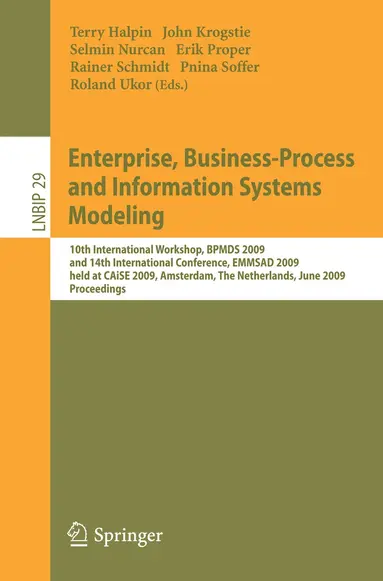
Enterprise, Business-Process and Information Systems Modeling
Terry Halpin, John Krogstie, Selmin Nurcan, Erik Proper, Rainer Schmidt, Pnina Soffer, Roland Ukor
Häftad, 2009
569 kr
Journal on Data Semantics XI
John F. Roddick, Pavel Shvaiko, Vojtech Svatek, Steffen Staab, Terry Halpin, Philippe Thiran, Jeff Z. Pan
734 kr