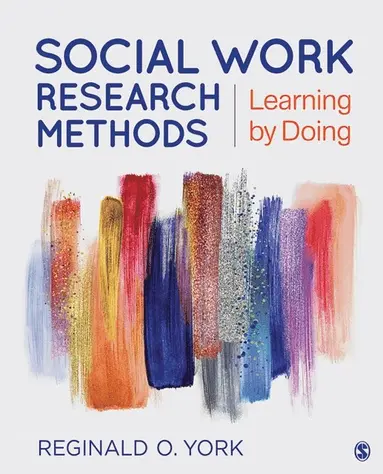
Social Work Research Methods
Learning by Doing
3 054 kr
Beställningsvara. Skickas inom 3-6 vardagar. Fri frakt över 249 kr.
Fler format och utgåvor
Beskrivning
Produktinformation
- Utgivningsdatum:2019-07-23
- Mått:187 x 231 x 25 mm
- Vikt:910 g
- Format:Häftad
- Språk:Engelska
- Antal sidor:544
- Upplaga:1
- Förlag:SAGE Publications Inc
- ISBN:9781506387192
Utforska kategorier
Mer om författaren
Reginald O. York, PhD, is a professor in the School of Social Work at the University of North Carolina Wilmington. Previously, he served on the social work faculties of East Carolina University and the University of North Carolina Chapel Hill. He is the author of Human Service Planning (The University of North Carolina Press, 1982), Building Basic Competencies in Social Work Research (Allyn and Bacon, 1997), Conducting Social Work Research (Allyn and Bacon, 1998), Evaluating Social Work Practice (Pearson, 2009), and Statistics for Human Service Evaluation (Sage Publications, 2017). Prior to his entry into academia, he served as a foster care social worker, a child protective services supervisor, and the director of two human service organizations. His research interests include evidence-based practice, social work education, and human service management.
Recensioner i media
"This book provides hands-on knowledge to student learners in a way that grounds their classroom learning with professional practice expectations."
Innehållsförteckning
- PrefaceAcknowledgmentsAbout the AuthorPart 1: The Fundamentals of Science and Social Work ResearchChapter 1: Science, Research, and Social Work PracticeHow do we Know what we Know?Avoiding Errors in Decision MakingScience as a Way of KnowingScience and Critical ThinkingSocial Work Practice and ScienceCommon Sense and the Scientific MethodPseudoscience as an Alternative to ScienceApplying the Basic Principles of Science: Does the Full Moon Make Us Different?Chapter 2: Purposes and Processes of Social Work ResearchFour Purposes of Social Work ResearchQuantitative and Qualitative MeasurementThe Research ProcessChapter 3: Ethics and Cultural Competence in Social Work ResearchSection A: Ethics in the Use of Human Subjects in ResearchSection B: Cultural Competence in Social Work ResearchChapter 4: Evidence-based PracticeThe Nature of Evidence and Evidence-based PracticeSteps in the Process of Evidence-based PracticeCritical Appraisal of Evidence-based PracticePart 2: Conducting Different Types of Social Work ResearchChapter 5: Conducting Research that Employs Social SurveysThe Nature of the Social SurveyTypes of Social SurveysWhen to Use Each Type of SurveyConducting Your Own Social SurveyComposing Your Own QuestionnaireAdvantages and Disadvantages of the SurveyChapter 6: Conducting Research That Describes People: What Are the Traits That Describe the Good Manager?Preliminary Step for Practice Exercise 2 for This ChapterTypes of Social Work ResearchThe Phases of Descriptive ResearchChapter 7: Conducting Research That Explains Things: What Explains Life Satisfaction?The Four Major Phases of Explanatory ResearchAn Explanatory Research Study Example: Does Stress or Social Support Explain Life Satisfaction?Chapter Appendix: Questionnaire for Study of Life SatisfactionChapter 8: Conducting Research that Evaluates ServicesThe Parts of the Evaluation SystemThe Phases of Outcome Evaluation ResearchResearch Example: Are the Services of the New Horizons Treatment Program Effective in the Reduction of Depression for Adult Clients?Chapter Appendix: Statistical Analysis of the Data for the New Horizons Treatment ProgramChapter 9: Conducting Qualitative Research that Explores the UnknownExploratory Research and Qualitative Research MethodsWhat Quantitative and Qualitative Approaches to Research Have in CommonThe Phases of Exploratory Research Employing Qualitative Research MethodsApproaches to Qualitative ResearchData Collection in Qualitative ResearchData Analysis in Qualitative ResearchChapter 10: Conducting Program EvaluationsWhat Does Your Agency Do to Evaluate Programs?The Nature of Program EvaluationsAdvantages of Program EvaluationsCharacteristics of Good ProgramsFinding Evidence for Human Service ProgramsTypes of Program EvaluationsThe Logic Model as a Way of Portraying Critical Aspects of the Program EvaluationSome Qualitative Approaches for Program EvaluationIssues in Program EvaluationPart 3: Conducting Each Phase of Social Work ResearchChapter 11: Developing Your Knowledge Base and InterventionPurpose and Knowledge as the Foundation for the Research StudyThe Literature Review for a Research StudyDescribing the Intervention or ProgramPreliminary Information for the Practice ExercisesChapter 12: Drawing Your Study SampleThe Study Sample and the Study PopulationGeneralization of Study ResultsSampling ErrorSampling Elements, Sampling Frames, and Sampling IntervalsRandom Samples and Scientific GeneralizationNonrandom Samples and Logical GeneralizationChapter 13: Measuring Your Study VariablesWhy Fret Over Measurement?The Nature of Measurement in Social Work ResearchStandardized Tools and Individualized ToolsMeasurement ErrorReliability and Validity in Qualitative MeasurementSecuring the Tool for Measuring Your Study VariablesEvaluating Measurement ToolsTips for Developing Your Own Measurement ToolComputing the Score for Your ScaleDescribing Your Measurement ToolDetermining Practical Significance With Your Measurement MethodSpecial Challenges of the Single-Subject Research StudyIndividualized Scales as an OptionChapter 14: Selecting a Research Design for a Group Evaluation StudyThe Nature of Causation in ResearchThreats to Internal ValidityWhat Threats Should Be of Special Concern in My Situation?Two General Types of Research DesignsGroup Research DesignsPreexperimental Designs That Fail to Address Threats to Internal ValidityQuasi-Experimental Designs That Address Causation MinimallyExperimental Designs That Address Threats OptimallySummary of Group Research DesignsChapter 15: Selecting a Research Design for a Single ClientThe Nature of the Single-Subject Research StudySingle-Subject Designs that Fail to Address Maturation or HistorySingle-Subject Designs that Address MaturationSingle-Subject Designs That Address Both Maturation and HistoryData Analysis for Single-Subject ResearchChapter 16: Analyzing Data and Drawing ConclusionsUsing Descriptive Statistics to Describe PeopleUsing Inferential Statistic to Test Your Hypothesis in Explanatory ResearchQuestions You Must Answer to Find Your Statistic in Explanatory ResearchFinding Your Statistic in Explanatory ResearchInterpreting Data in Explanatory ResearchUsing Inferential Statistics to Test Your Hypothesis When You Are Evaluating PracticePresenting Your Study ConclusionsChapter Appendix: Instructions for Using an Internet Website to Analyze DataChapter 17: Analyzing Qualitative DataAn Overview of Qualitative Data AnalysisNarrative AnalysisGlossaryReferencesIndex
Du kanske också är intresserad av
- Signerad!
- -52%
Pixi adventskalender 2025 : Med böcker av Maria Trolle, Maria Nilsson Thore, Johan Anderblad, Filippa Widlund, Mårten Melin Elsa Beskow, Lotta Olsson mfl
Flera Författare
Häftad, 2025
129 kr269 kr
- -48%
Pixi adventskalender – Mattias Andersson
Bonnier Carlsen
Häftad, 2024
129 kr249 kr