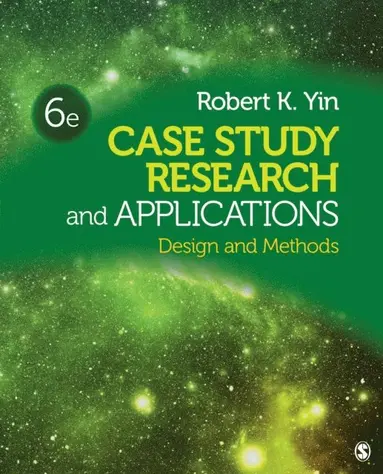
Winner of the 2019 McGuffey Longevity Award from the Textbook & Academic Authors Association (TAA) Recognized as one of the most cited methodology books in the social sciences, the Sixth Edition of Robert K. Yin′s bestselling text provides a complete portal to the world of case study research. With the integration of 11 applications in this edition, the book gives readers access to exemplary case studies drawn from a wide variety of academic and applied fields. Ultimately, Case Study Research and Applications will guide students in the successful use and application of the case study research method.
Robert K. Yin is President of COSMOS Corporation, an applied research and social science firm. Over the years, COSMOS has successfully completed hundreds of projects for federal agencies, state and local agencies, and private foundations.Outside of COSMOS, Dr. Yin has assisted numerous other research groups, helping to train their field teams or to design research studies. The most recent such engagements have been with The World Bank, the Division of Special Education and disAbility Research at George Mason University, the Department of Nursing Research and Quality Outcomes at the Children’s National Health System (Washington, DC), and the School of Education, Southern New Hampshire University.Dr. Yin has authored over 100 publications, including authoring or editing 11 books (not counting the multiple editions of any given book). Earlier editions of the present book have been translated into eight languages (Chinese, Japanese, Korean, Swedish, Romanian, Italian, Polish, and Portuguese), and a second book on Qualitative Research from Start to Finish (2016) is in its 2nd edition and has been translated into four languages (Chinese, Korean, Swedish, and Portuguese). Dr. Yin received his B.A. in history from Harvard College (magna cum laude) and his Ph.D. in brain and cognitive sciences from MIT.
Recensioner i media
"The book is filled with tips to the researcher on how to master the craft of doing research overall and specifically how to account for multi-layered cases."
Innehållsförteckning
ForewordPrefaceAcknowledgmentsAbout the AuthorChapter 1. Getting Started: How to Know Whether and When to Use the Case Study as a Research MethodBeing Ready for the Challenge, and Setting High ExpectationsComparing Case Studies With Other Social Science Research MethodsVariations in Case Studies, but a Common DefinitionAddressing Traditional Concerns About Case Study ResearchSummaryNotes to Chapter 1Chapter 2. Designing Case Studies: Identifying Your Case(s) and Establishing the Logic of Your Case StudyGeneral Approach to Designing Case StudiesThe Role of Theory in Research DesignsCriteria for Judging the Quality of Research DesignsCase Study Research DesignsModest Advice in Selecting Case Study DesignsNotes to Chapter 2Application #1: An Exploratory Case Study: How New Organizational Practices Become RoutinizedApplication #2: Defining the “Case” in a Case Study: Linking Job Training and Economic Development Initiatives at the Local LevelApplication #3: How “Discovery” Can Occur in the Field: Social Stratification in a Midsized CommunityChapter 3. Preparing to Collect Case Study Evidence: What You Need to Do Before Starting to Collect Case Study DataThe Case Study Researcher: Desired Skills and ValuesPreparation and Training for a Specific Case StudyThe Case Study ProtocolScreening the Candidate Cases for Your Case StudyThe Pilot Case StudySummaryNotes to Chapter 3Chapter 4. Collecting Case Study Evidence: The Principles You Should Follow in Working With Six Sources of EvidenceSix Sources of EvidenceFour Principles of Data CollectionSummaryNotes to Chapter 4Application #4: Doing Interviews in the Field: Citizens on PatrolApplication #5: Making Field Observations: First Day in an Urban NeighborhoodApplication #6: Assembling a Question-and-Answer Database: A Case Study of a Community OrganizationChapter 5. Analyzing Case Study Evidence: How to Start Your Analysis, Your Analytic Choices, and How They WorkAn Analytic Strategy: More Than Relying on Analytic ToolsFive Analytic TechniquesPressing for a High-Quality AnalysisSummaryNotes to Chapter 5Application #7: Using a Case Study to Compare Directly Competing Rival Hypotheses: Whether Military Base Closures Produce Catastrophic Economic Impacts or NotApplication #8: A Nutshell Example of an Explanatory Case Study: How a Federal Award Affected a University Computer DepartmentApplication #9: An Explanatory Case Study: Transforming a Business Firm Through Strategic PlanningChapter 6. Reporting Case Studies: How and What to ComposeAudiences for Case Study ResearchVarieties of Case Study CompositionsProcedures in Composing a Case StudyWhat Makes an Exemplary Case Study?Notes to Chapter 6Application #10: A Multiple-Case Study Integrating Qualitative and Quantitative Data: Proposal Processing at 17 UniversitiesAppendix A. A Note on the Uses of Case Study Research in PsychologyAppendix B. A Note on the Uses of Case Study Research in EvaluationsApplication #11: An Evaluation Case Study: Evaluation of a Community Coalition’s CampaignBrief Glossary of Terms Directly Related to Case Study ResearchReferencesAuthor IndexSubject Index