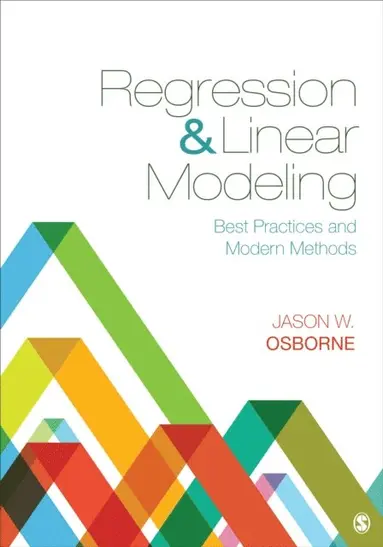
Regression & Linear Modeling
Best Practices and Modern Methods
2 586 kr
Beställningsvara. Skickas inom 3-6 vardagar. Fri frakt över 249 kr.
Fler format och utgåvor
Beskrivning
Produktinformation
- Utgivningsdatum:2016-06-21
- Mått:177 x 254 x 34 mm
- Vikt:1 100 g
- Format:Inbunden
- Språk:Engelska
- Antal sidor:488
- Upplaga:1
- Förlag:SAGE Publications Inc
- ISBN:9781506302768
Utforska kategorier
Mer om författaren
Jason W. Osborne is a thought leader and professor in higher education. His background in educational psychology, statistics and quantitative methods, along with that gleaned from high-level positions within Academia gives a unique perspective on the real-world data factors. In 2015, he was appointed Associate Provost and Dean of the Graduate School at Clemson University in Clemson, South Carolina. As well as Associate Provost, at Clemson University, Jason was a Professor of applied statistics at the School of Mathematical Sciences, with a secondary appointment in Public Health Science. In 2019, he took on the role of Provost and Executive VP for Academic Affairs at Miami University. As Provost, Jason implemented a transformative strategic plan to reposition the institution as one prepared for new challenges with a modern, compelling curriculum, a welcoming environment, and enhanced support for student faculty positions and staff. In 2021, he was named by Stanford University as one of the top 2% researchers in the world, underlining his commitment to world-class research methods across particular domains, ultimately influencing a generation of learners. Currently, Jason teaches and publishes on data analysis "best practices" in quantitative and applied research methods. He has served as evaluator or consultant on research projects and in public education (K-12), instructional technology, health care, medicine and business. He served as founding editor of Frontiers in Quantitative Psychology and Measurement and has been on the editorial boards of several other journals (such as Practical Assessment, Research, and Evaluation). Jason W Osborne also publishes on identification with academics and on issues related to social justice and diversity. He has written seven books covering topics to communicate logistic regression and linear modeling, exploratory factor analysis, best practices and modern research methods, data cleaning, and numerous other topics.
Recensioner i media
"I really enjoyed reading this, which is rare to say about a statistics textbook. The style of writing is very approachable, and the material is presented in a way that is informative even to someone who thinks about these topics often."
Innehållsförteckning
- Chapter 1: A Nerdly ManifestoThe Variables Lead the WayDifferent Classifications of MeasurementIt’s All About Relationships!A Brief Review of Basic Algebra and Linear EquationsThe GLM in One ParagraghA Brief Consideration of PredictionA Brief Primer on Null Hypothesis Statistical TestingA Tale of Two ErrorsWhat Conclusions Can We Draw Based on NHST Results?So What Does Failure to Reject the Null Hypothesis Mean?Moving Beyond NHSTThe Importance of Replication and GeneralizabilityWhere We Go From HereEnrichmentChapter 2: Basic Estimation and AssumptionsEstimation and the GLMWhat Is OLS Estimation?ML Estimation—A Gentle but Deeper LookAssumptions for OLS and ML EstimationSimple Univariate Data Cleaning and Data TransformationsWhat If We Cannot Meet the Assumptions?Where We Go From HereEnrichmentChapter 3: Simple Linear Models With Continuous Dependent Variables: Simple Regression AnalysesAdvance OrganizerIt’s All About Relationships!Basics of the Pearson Product-Moment Correlation CoefficientCalculating rEffect Sizes and rA Real Data ExampleThe Basics of Simple RegressionBasic Calculations for Simple RegressionStandardized Versus Unstandardized Regression CoefficientsHypothesis Testing in Simple RegressionA Real Data ExampleDoes Centering or z-Scoring Make a Difference?Some Simple Multivariate Data CleaningSummaryEnrichmentChapter 4: Simple Linear Models With Continuous Dependent Variables: Simple ANOVA AnalysesAdvance OrganizerIt’s All About Relationships! (Part 2)Analyzing These Data via t-TestAnalyzing These Data via ANOVAANOVA Within an OLS Regression FrameworkWhen Your IV Has More Than Two Groups: Dummy Coding Your Unordered Polytomous VariableSmoking and Diabetes Analyzed via ANOVASmoking and Diabetes Analyzed via RegressionWhat If the Dummy Variables Are Coded Differently?Unweighted Effects CodingWeighted Effects CodingCommon Alternatives to Dummy or Effects CodingSummaryEnrichmentChapter 5: Simple Linear Models With Categorical Dependent Variables: Binary Logistic RegressionAdvance OrganizerIt’s All About Relationships! (Part 3)The Linear Probability ModelHow Logistic Regression Solves This Issue: The Logit Link FunctionA Brief Digression Into Probabilities, Conditional Probabilities, and OddsSimple Logistic Regression Using Statistical SoftwareThe Logistic Regression EquationInterpreting the ConstantWhat If You Want CIs for the Constant?Summary So FarLogistic Regression With a Continuous IVSome Best Practices When Using a Continuous Variable in Logistic RegressionTesting Assumptions and Data Cleaning in Logistic RegressionHosmer and Lemeshow Test for Model FitSummaryEnrichmentAppendix 5A: A Brief Primer in Probit RegressionChapter 6: Simple Linear Models With Polytomous Categorical Dependent Variables: Multinomial and Ordinal Logistic RegressionAdvance OrganizerUnderstanding Marijuana UseDummy-Coded DVs and Our Hypotheses to Be TestedBasics and CalculationsMultinomial Logistic Regression (Unordered) With Statistical SoftwareMultinomial Logistic Regression With a Continuous PredictorMultinomial Logistic Regression as a Series of Binary Logistic RegressionsData Cleaning and Multinomial Logistic RegressionTesting Whether Groups Can Be CombinedOrdered Logit (Proportional Odds) ModelAssumptions of the Ordinal Logistic ModelInterpreting the Results of the Ordinal RegressionInterpreting the Intercepts/ThresholdsInterpreting the Parameter EstimatesData Cleaning and More Advanced Models in Ordinal Logistic RegressionThe Measured Variable is Continous, Why Not Just Use OLS Regression for This Type of Analysis?A Brief Note on Log-Linear AnalysesSummary and ConclusionsEnrichmentChapter 7: Simple Curvilinear ModelsAdvance OrganizerZeno’s Paradox, a Nerdy Science Joke, and Inherent Curvilinearity in the Universe…A Brief Review of Simple AlgebraHypotheses to Be TestedIllegitimate Causes of CurvilinearityDetection of Nonlinear EffectsBasic Principles of Curvilinear RegressionCurvilinear OLS Regression Example: Size of the University and Faculty SalaryData CleaningInterpreting Curvilinear Effects EffectivelyReality Testing This EffectSummary of Curvilinear Effects in OLS RegressionCurvilinear Logistic Regression Example: Diabetes and AgeCurvilinear Effects in Multinomial Logistic RegressionReplication Becomes ImportantMore Fun With Curves: Estimating Minima and Maxima as Well as Slope at Any Point on the CurveSummaryEnrichmentChapter 8: Multiple Independent VariablesAdvance OrganizerThe Basics of Multiple PredictorsWhat Are the Implications of This Act?Hypotheses to Be Tested in Multiple RegressionAssumptions of Multiple Regression and Data CleaningPredicting Student Achievement From Real DataTesting Assumptions and Data Cleaning in the NELS88 DataMethods of Entering VariablesUsing Multiple Regression for Theory TestingLogistic Regression With Multiple IVsAssessing the Overall Logistic Regression Model: Why There Is No R2 for Logistic RegressionSummary and conclusionsExercisesChapter 9: Interactions Between Independent Variables: Simple moderationAdvance OrganizerWhat is an Interaction?Procedural and Conceptual Issues in Testing for Interactions Between Continuous VariablesProcedural and Conceptual Issues in Testing for Interactions Containing Categorical VariablesHypotheses to Be Tested in Multiple Regression With Interactions PresentAn OLS Regression Example: Predicting Student Achievement From Real DataInterpreting the Results From a Significant InteractionGraphing Interaction EffectsAn Interaction Between a Continuous and a Categorical Variable in OLS RegressionInteractions With Logistic RegressionExample Summary of Interaction AnalysisInteractions and Multinomial Logistic RegressionExample Summary of FindingsCan These Effects Replicate?Post Hoc Probing of InteractionsSummaryEnrichmentChapter 10: Curvilinear Interactions Between Independent VariablesAdvance OrganizerWhat is a Curvilinear Interaction?A Quadratic Interaction Between X and ZA Cubic Interaction Between X and ZA Real-Data Example and Exploration of Procedural DetailsCurvilinear Interactions Between Continuous and Categorical VariablesCurvilinear Interactions With Categorical DVs (Multinomial Logistic)Curvilinear Interaction Effects in Ordinal RegressionChapter SummaryEnrichmentChapter 11: Poisson Models: Low-Frequency Count Data as Dependent VariablesAdvance OrganizerThe Basics and Assumptions of Poisson RegressionWhy Can’t We Just Analyze Count Data via OLS, Multinomial, or Ordinal Regression?Hypotheses Tested in Poisson RegressionPoisson Regression With Real DataInteractions in Poisson regressionData Cleaning in Poisson RegressionRefining the Model by Eliminating Excess (Inappropriate) ZerosA Refined Analysis With Excess Zeros RemovedCurvilinear Effects in Poisson RegressionDealing With Overdispersion or UnderdispersionNegative Binomial ModelSummary and ConclusionsEnrichmentChapter 12: Log-Linear Models: General Linear Models When All of Your Variables Are Unordered CategoricalAdvance OrganizerThe Basics of Loglinear AnalysisHypotheses Being TestedAssumptions of Loglinear ModelsA Slightly More Complex Loglinear ModelCan We Replicate These Results in Logistic Regression?Data Cleaning in Loglinear ModelsSummary and ConclusionsEnrichmentChapter 13: A Brief Introduction to Hierarchical Linear ModelingAdvance OrganizerWhy HLM models Are NecessaryHow Do Hierarchical Models Work? A Brief PrimerGeneralizing the Basic HLM ModelResiduals in HLMResults of DROPOUT Analysis in HLMSummary and ConclusionsEnrichmentChapter 14: Missing Data in Linear ModelingAdvance OrganizerNot All Missing Data Are the SameCategories of Missingness: Why Do We Care If Data Are MCAR or Not?How Do You Know If Your Data Are MCAR, MAR, or MNAR?What Do We Do With Randomly Missing Data?Data MCARData MNARHow Missingness Can Be an Interesting Variable in and of ItselfSumming Up: Benefits of Appropriately Handling Missing DataEnrichmentChapter 15: Trustworthy Science: Improving Statistical ReportingAdvance OrganizerWhat Is Power, and Why Is It Important?Power in Linear ModelsSummary of Points Thus FarWho Cares as Long as p
Du kanske också är intresserad av
- -15% på allt
- -15% på allt
- Signerad!
SIGNERAD - Mackans kost : Middagar och matlådor
Marcus Frank
Inbunden, 2026
269 kr
- Signerad!
- -52%
Pixi adventskalender 2025 : Med böcker av Maria Trolle, Maria Nilsson Thore, Johan Anderblad, Filippa Widlund, Mårten Melin Elsa Beskow, Lotta Olsson mfl
Flera Författare
Häftad, 2025
129 kr269 kr