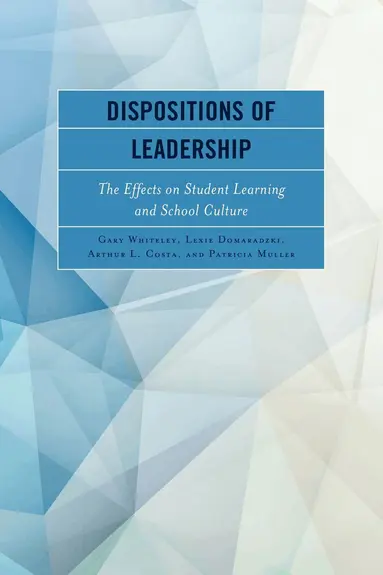
Dispositions of Leadership
The Effects on Student Learning and School Culture
AvArthur L. Costa,Patricia Muller
593 kr
Beställningsvara. Skickas inom 10-15 vardagar. Fri frakt över 249 kr.
Beskrivning
Produktinformation
- Utgivningsdatum:2017-08-31
- Mått:152 x 229 x 12 mm
- Vikt:346 g
- Format:Häftad
- Språk:Engelska
- Antal sidor:198
- Förlag:Bloomsbury Publishing Plc
- ISBN:9781475836264
Utforska kategorier
Mer om författaren
Gary Whiteley's passion for understanding the nature and implication of effective school leadership spans four decades. His leadership journey continues to be enhanced by thoughtful colleagues who co-authored this book. Lexie Domaradzki has dedicated her professional career to supporting high needs schools. She is honored to have the privilege of assisting educators in developing the leadership capabilities and practices that assist them in solving complex problems. Art Costa has devoted his career to improving education through self-directed learning and more thought-full instruction and assessment. He is noted for his many publications and the development of the Habits of Mind and Cognitive Coaching. He is a past president of ASCD. Patricia Muller provides schools, districts, departments of education, non-profit organizations and foundations with evaluation support, capacity- building and technical assistance. In her two decades with the Center for Evaluation and Education Policy at Indiana University, some of her most rewarding work has been with school leadership programs.
Recensioner i media
Dispositions of Leadership: The Effects on Student Learning and School Culture is a treasure trove of insights for experienced and aspiring school leaders alike. The brilliance is in how the information is shared. It is not a "how to book" but rather a "can do book." The dispositions are presented as a framework for thinking and learning, and it is up to the reader to transform this information into action. The research is rich and the supporting stories based on real experience are compelling. This book exemplifies potential and promise for today's school leaders. -- Russell J. Quaglia, Author of School Voice: The Instrument of Change; Principal Voice: Listen, Learn, Lead; and, Aspire High: Imagining Tomorrow's School Today, Executive Director, Quaglia Institute for Student Aspirations School leaders who embrace the high goal that every child will grow and learn to their fullest will find this book speaking directly and personally to them. This is no cookbook with limited ingredients and oversimplified methods. It's a guide to the vital inner workings of successful leadership. Dispositions of Leadership: The Effects on Student Learning and School Culture reveals how effective leaders think flexibly, interact sensitively, and engage others in the solution of problems. Leadership here is responsive, creative, and adaptive - three essential qualities of the modern school seeking to accommodate the student diversity and demands of an ever-changing world. Practicing principals, teacher leaders, and others will find wisdom here to guide their daily rounds: five dispositions that they can practice and model for others and that can serve as the heart of their own learning and professional growth. This book deserves to be read widely. In its emphasis on networking leaders within and across districts in "communities of leaders" lies the key to our profession's future success. -- Gordon A. Donaldson, Ed.D., Professor Emeritus of Education, University of Maine This book offers a contemporary focus on five dispositions for leadership in an agile organization. The book offers a theoretical framework, indicators for changes in leadership roles, and practical examples of how it looks in schools that are transforming based on ever-changing internal and external demands. I am eager to give this tomorrow to school leaders with whom I work! -- Bena Kallick, co-founder and co-director, Institute for Habits of Mind How do we prepare leaders to work in this environment? Adaptability expressed by Heifetz years ago is becoming a necessary skills. By using the dispositions written about in this book, we can adapt our responses by creating a Vision, Understanding, Clarity, and Agility. You will find several references to agility, as well as other foundational behaviors. It is knowing the dispositions and having the agility to use when necessary to confront, manage, and move forward in solving to be more successful in an ever-changing world. -- William A. Sommers, Retired Principal, Bricoleur and Leadership Coach If you could choose one book on the effective practices of the school principal in the 21st Century, this is the one!! The authors have synthesized salient research in the field of educational leadership and artfully applied it to the implementation of tools and dispositions of the craft. It creates a backdrop for personal reflection, metacognition and professional growth to become a dynamic leader in our ever-changing world. It is a must read for all educational leaders from the teacher leader, school principal to district administrator. -- Robyn G. Rehmann, principal coach and educational consultant, Anchorage, Alaska
Innehållsförteckning
- Dedication List of Figures List of Tables Foreword Preface Acknowledgements Introduction Complexity of the Contemporary Educational System Why Are New Understandings of Educational Leadership Needed? Learning Environments and the Need for Adaptive Competence Habits of Mind or Dispositions Educational Leadership in the Information Age Overview of the Book Questions to Engage your Thinking and Discussion with Colleagues References Chapter One: What Effect Does Educational Leadership Have on Student Learning? The Century-Long Evolution of Educational Leadership Twenty-five Important Works in Five Tables Efficiency, Bureaucracy, and the Heroic Leader - 1911-1967 Transformational Leadership and the Learning Organization - 1978-1990 Adaptive Leadership a Response for Addressing Complexity - 1993-2003 The Agile Organization and Adaptive Leadership - 2005-2009 A Home of Our Own Emerges: Leading Linked with Student Learning - 2011- 2013 Summary of the Five Tables and 25 Important Books for Leadership and Learning A New Era of Leadership with Student Learning as the Pervasive Focus Leadership Dimensions and Core Leadership Practices: Broader-Grained Work The Three Capabilities and Four Pathways: Finer-Grained Leadership Work Summary Questions to Engage Your Thinking and Discussion with Colleagues References Chapter Two: How Does an Agile Organization Support Contemporary School Leadership? The Formal Organization: An Overview Formal Organization: Routine Analytical and Routine Cognitive Problem Solving Agile Organizations: Adapting the Formal Organization to Meet 21st Century Needs Agile Organizations: Non-Routine Analytical and Interactive Problem Solving Asserting Focus Amidst Complexity: A Challenge in the Information Age Agility: Identifying the Type of Problem or Challenge Technical Problems, Adaptive Challenges, and Polarity Management Network-centric Collaborative Groups, Agility, and Decision-making High-Performing Principal Teams and School-based Leadership Teams Summary Questions to Engage your Thinking and Discussion with Colleagues References Chapter Three: What Are the Dispositions of Contemporary Educational Leadership? What are Dispositions? Why Dispositions? Dispositions for Educational Leadership What Roles Do Dispositions Serve in Leadership? How are Dispositions Acquired? Why Consider Utilizing Thinking Dispositions with Educators? Dispositions Build the School Culture The Five Dispositions of Leadership Dispositions, Capabilities, and Practices: Ways of Thinking, Being, Doing The Balcony and the Dance Floor Summary Questions to Engage your Thinking and Discussion with Colleagues: References Chapter Four: Disposition: Thinking and Acting Interdependently Capability One: Establishing and Maintaining an Environment of Trust that Includes Predictable Values and Predictable Skills Capability Two: Identifying, Articulating, and Aligning with a Shared Vision that Addresses a Pervasive Focus on Student and Adult Learning Capability Three: Promote a Group of Diverse Individuals to Access and Utilize Resources and Expertise Across a Broader Community Capability Four: Setting Aside Your Own Preferences for the Benefit of All Capability Five: Having the Capacity to Look at Things from Others' Point of View Capability Six: Anticipating Ways to Support Others in the Collaborative Process Summary Middle School Vignette Questions to Engage your Thinking and Discussion with Colleagues References Chapter Five: Communicating to Influence Capability One: Developing the Capabilities within Others to Interact Successfully Discussion Dialogue Capability Two: Developing Personal Presence Capability Three: Knowing When and Why to Integrate and Knowing When to Insert Oneself Capability Four: Use Interpersonal Skills to Cultivate Working Relationships and to Motivate and Mobilize Others (Individuals and Groups) Summary Middle-school Vignette Questions to Engage your Thinking and Discussion with Colleagues References Chapter Six: Gathering and Applying Information for Change Capability One: Systematically and Intentionally Gathering and Organizing Needed Data Academic Content and Measures of Schooling Student Engagement in the Behavior, Emotional, And Cognitive Dimensions Information Collected for Evaluating Implementation Topics Capability Two: Using data to inform actions Capability Three: Developing and Nurturing an Environment of Inquiry and Innovation Grounded in Reflection and Continuous Improvement Summary Middle School Vignette Questions to Engage Your Thinking and Discussion with Colleagues References Chapter Seven: Seeking Support for Feedback and Learning Capability One: Developing Self-Knowledge, Self-Awareness and Self-Efficacy While Maintaining a Sense of Humility Capability Two: Frequently Seeking Feedback Focused on Learning and Professional Growth Capability Three: Engaging in a Collegial Networked Leadership Community of High-Performing Teams of Principals Problems of Practice Versus Practice-Based Evidence Effective Networked Leadership Communities Relationship Between Support, Resiliency, Feedback and Excellence Professional Goal Setting Capability Four: Creating Feedback Spirals for Continuous Individual and Organizational Self-Learning Receiving Feedback Giving Feedback Summary Middle School Vignette Questions to Engage Your Thinking and Discussion with Colleagues Chapter Eight: Pursuing Adaptive Competence What is Adaptive Competence? Pursuing Adaptive Competence in Ambiguous Environments Capability One: Using Self-Managing, Self-Monitoring, and Self-Modifying Skills to Inform Behaviors and Actions Capability Two: Engaging Flexibly in Thinking and Behaviors Capability Three: Solving Complex Problems and Addressing Adaptive Challenges Summary Middle School Vignette: Three Middle School Principals Questions to Engage Your Thinking and Discussion with Colleagues: References Chapter Nine: Discovering Leadership Potential in an Agile Organization Five Dispositions of Leadership: 1.Thinking and Acting Interdependently: Promoting a positive, collaborative learning culture through distributed leadership. 2.Communicating to Influence: Developing the interpersonal skills to influence, mobilize and motivate individuals and groups. 3.Gathering and Appling Information for Change: Utilizing data-based evidence to make decisions and provide formative feedback for setting direction and planning change. 4.Seeking Support and Feedback for Learning: Fostering personal/professional growth and resiliency. 5.Pursuing Adaptive Competence (Keystone Disposition): Incorporating into practice metacognition and cognitive flexibility to effectively plan, reflect, diagnose, and solve complex problems. Feedback: A Networked Leadership Community Vignette Questions for Reflection
Mer från samma författare
Envisioning Process as Content
Arthur L. Costa, Rosemarie M. Liebmann, Arthur L. Costa, Rosemarie M. Liebmann
Inbunden, 1997
1 170 kr
The Process-Centered School
Arthur L. Costa, Rosemarie M. Liebmann, Arthur L. Costa, Rosemarie M. Liebmann
Inbunden, 1997
1 217 kr
Academic Conferences for Teachers and School Leaders: A K-12 Guide to Creating Collaboration for Teachers, School, and District Leaders
Arthur L. Costa, Eli R. Johnson
Häftad
400 kr
Du kanske också är intresserad av
- -15% på allt
Dispositions of Leadership
Gary Whiteley, Lexie Domaradzki, Arthur L. Costa, Patricia Muller
Inbunden, 2017
1 123 kr
Legen einer Wasserwelle an einem Teilbereich des Medium (Unterweisung Friseur/in)
Patricia Müller
Häftad, 2015
338 kr
Lernstufen Mathematik 10. Jahrgangsstufe - Mittelschule Bayern - Schülerbuch
Andrea Kristina Deeg, Corina Engelstätter, Max Friedl, Christian Geus, Daniel Hafner, Christian Koenig, Dirk Lüer, Patricia Müller, Thomas Müller, Judith Pohmann, Dorothea Schäbel
Inbunden, 2022
433 kr
Geschlechtererziehung in der Grundschule. Staatliche und kirchliche Verlautbarungen im Vergleich
Patricia Müller
Häftad, 2007
802 kr
Die neuen besitzlosen Mobiliarsicherheiten des französischen Rechts im Vergleich zum deutschen Mobiliarsicherungsrecht
Patricia Müller
Häftad, 2019
290 kr