
Optimizing Laparoscopic Suturing Proficiency Through Data-Driven Training Analytics
Inbunden, Engelska, 2026
2 683 kr
Kommande. Bevaka för att få ett mejl när produkten kan beställas.
Beskrivning
Discover how integrating AI, computer vision, and real-time data analytics bridge the gap between surgical theory and clinical mastery by replacing subjective training with objective, personalized skill development. The integration of artificial intelligence, machine learning, and optimization techniques into laparoscopic suturing training represents a significant advancement in both medical education and computational intelligence. As minimally invasive surgery becomes the standard in many procedures, the need for precise, efficient, and scalable training methods has intensified. Traditional surgical training relies heavily on subjective assessments and resource-intensive mentorship, which often leads to inconsistencies in skill development. The rise of computer vision, real-time performance tracking, and AI-driven adaptive learning is transforming surgical education by providing objective, data-driven feedback and personalized learning pathways. This book focuses on data-driven optimization techniques for laparoscopic suturing training, employing advanced computational intelligence methods to enhance surgical education. It covers key areas such as machine learning, computer vision, and optimization algorithms to analyze and improve trainees’ performance. The book presents methodologies for evaluating motion efficiency, suturing accuracy, and force application, using data-driven feedback systems to refine surgical skills. Practical case studies and experimental results are included to demonstrate the effectiveness of these techniques. By integrating artificial intelligence and optimization techniques, it offers innovative approaches for objective skill assessment and real-time performance enhancement. The book is structured to provide both theoretical foundations and practical applications, making it accessible to a diverse audience, including researchers, educators, and medical professionals.
Produktinformation
Utforska kategorier
Mer om författaren
Hoppa över listan
Mer från samma författare
Artificial Intelligence for Renewable Energy systems
Ashutosh Kumar Dubey, Sushil Narang, Abhishek Kumar, Vicente Garc�a-D�az, Arun Lal Srivastav
Häftad, 2022
2 698 kr
Artificial Intelligence for Renewable Energy systems
Arun Lal Srivastav, Vicente Garcia-Diaz, Abhishek Kumar, Sushil Narang, Ashutosh Kumar Dubey
E-bok
20223 649 kr
Handbook on New Paradigms in Smart Charging for E-Mobility
Kumar,Abhishe, Abhishek Kumar, Ramesh C. Bansal, Praveen Kumar, Xiangning He
Häftad, 2025
1 820 kr
Handbook on New Paradigms in Smart Charging for E-Mobility
Xiangning He, Praveen Kumar, Ramesh C. Bansal, Abhishek Kumar
E-bok
20252 302 kr
Visualization Techniques for Climate Change with Machine Learning and Artificial Intelligence
Ashutosh Kumar Dubey, Abhishek Kumar, Sushil Kumar Narang, Moonis Ali Khan, Arun Lal Srivastav
Häftad, 2022
1 626 kr
Visualization Techniques for Climate Change with Machine Learning and Artificial Intelligence
Arun Lal Srivastav, Moonis Ali Khan, Sushil Kumar Narang, Abhishek Kumar, Ashutosh Kumar Dubey
E-bok
20222 278 kr
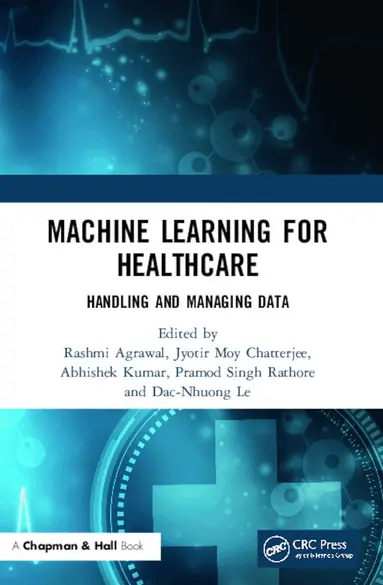
Machine Learning for Healthcare
Rashmi Agrawal, Jyotir Moy Chatterjee, Abhishek Kumar, Pramod Singh Rathore, Dac-Nhuong Le
Inbunden, 2020
1 838 kr
Machine Learning for Healthcare
Rashmi Agrawal, Jyotir Moy Chatterjee, Abhishek Kumar, Pramod Singh Rathore, Dac-Nhuong Le
Häftad, 2025
725 kr
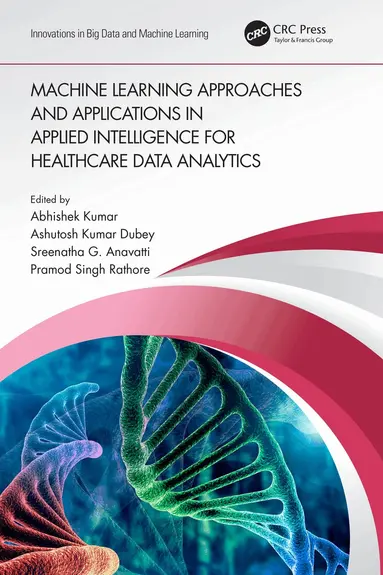
Machine Learning Approaches and Applications in Applied Intelligence for Healthcare Data Analytics
Abhishek Kumar, Ashutosh Kumar Dubey, Sreenatha G. Anavatti, Pramod Singh Rathore
Inbunden, 2022
2 601 kr
Hoppa över listan




Du kanske också är intresserad av
Nature-Inspired Intelligence for Complex Problems
T. Ananth Kumar, S. Oswalt Manoj, J. P. Ananth, Priya Batta, Abhishek Kumar
E-bok
20262 767 kr
Nature-Inspired Intelligence for Complex Problems
T. Ananth Kumar, S. Oswalt Manoj, J. P. Ananth, Priya Batta, Abhishek Kumar
E-bok
20262 726 kr
Blockchain Innovations for a Sustainable Circular Economy
J. Reyes Juarez Ramirez, T. Ananth Kumar, Pramod Singh Rathore, Priya Batta, Abhishek Kumar
E-bok
20262 948 kr
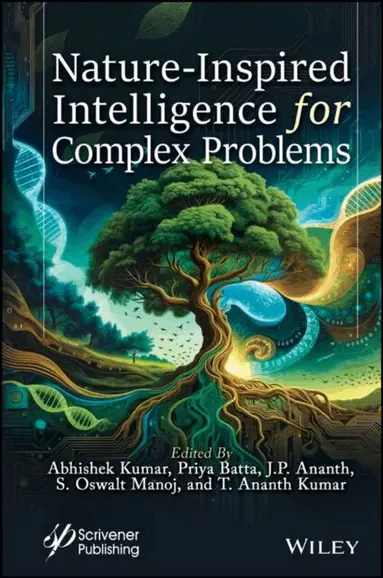
Nature-Inspired Intelligence for Complex Problems
Abhishek Kumar, Priya Batta, J. P. Ananth, S. Oswalt Manoj, T. Ananth Kumar
Inbunden, 2026
2 403 kr
Del 180
Blockchain Innovations for a Sustainable Circular Economy
Abhishek Kumar, Priya Batta, Pramod Singh Rathore, T. Ananth Kumar, J. Reyes Juárez Ramírez
Inbunden, 2026
2 237 kr
Integrating Algebraic Models with Generative AI and Blockchain for Healthcare
Abhishek Kumar, Priya Batta, T. Ananth Kumar, C. Dhaya, R. Srivel, K. Senthamilselvan
Inbunden, 2027
2 459 kr
Sharded Blockchain for In-Game Asset Management
Abhishek Kumar, Pooja Dixit, Pramod Singh Rathore, Dhaya C, R. Srivel
Inbunden, 2027
2 457 kr
Computational Intelligence
Puneet Kumar, Abhishek Kumar, Venkata Raghuveer Burugadda, E. Golden Julie, T. Ananth Kumar
E-bok
20243 149 kr