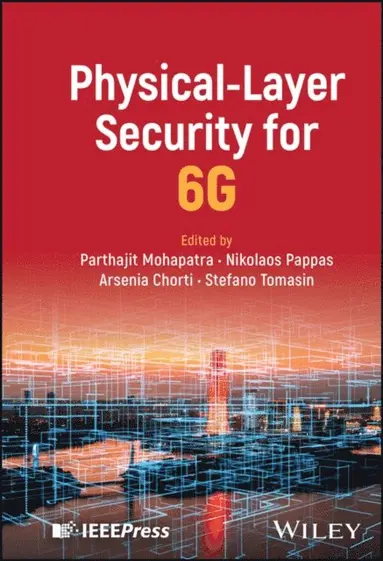
Physical-Layer Security for 6G
AvParthajit Mohapatra,Parthajit Mohapatra
1 450 kr
Beställningsvara. Skickas inom 7-10 vardagar. Fri frakt över 249 kr.
Fler format och utgåvor
Beskrivning
Produktinformation
- Utgivningsdatum:2024-11-13
- Mått:237 x 158 x 29 mm
- Vikt:780 g
- Format:Inbunden
- Språk:Engelska
- Antal sidor:384
- Förlag:John Wiley & Sons Inc
- ISBN:9781394170913
Utforska kategorier
Mer om författaren
Parthajit Mohapatra, PhD, is Associate Professor in the Department of Electrical Engineering, Indian Institute of Technology, India. His research focuses on physical-layer secrecy, short packet communication, union of networking & physical-layer techniques, and related areas. Nikolaos Pappas, PhD, is Associate Professor in the Department of Computer and Information Science, Linköping University, Sweden. His research concerns semantic wireless communications, network-level cooperative wireless networks, stochastic modeling, and related subjects. Arsenia Chorti, PhD, is Professor and Head of the Information, Communications and Imaging (ICI) Group of the ETIS Lab UMR8051, CY Cergy Paris Universite, France, and a Visiting Research Scholar at Princeton University, USA, and the University of Essex, UK. Her research focuses on physical-layer security, especially context-aware security, intrusion detection in IoT networks, and related subjects. Stefano Tomasin, PhD, is Professor at the University of Padova, Italy. His research concerns physical-layer security and signal processing for wireless communications, and he serves as Deputy EiC of the IEEE Transactions on Information Forensics and Security.
Innehållsförteckning
- About the Editors xiiiList of Contributors xvPreface xixPart I Preliminaries 11 Foundations of Physical-Layer Security for 6G 3Matthieu Bloch1.1 Coding Mechanisms 41.1.1 Channel Coding 51.1.2 Soft Covering 61.1.3 Source Coding with Side Information 71.1.4 Privacy Amplification 81.2 Coding for Physical-Layer Security 81.2.1 Secure Communication 91.2.2 Secret-Key Generation 111.3 Engineering and Learning Channels 12References 132 Coding Theory Advances in Physical-Layer Secrecy 19Laura Luzzi2.1 Introduction 192.2 Wiretap Coding Schemes Based on Coset Coding 202.2.1 LDPC Codes for Binary Erasure Wiretap Channels 212.2.2 Polar Codes for Binary Input Symmetric Channels 262.2.3 Lattice Codes for Gaussian and Fading Wiretap Channels 292.3 Wiretap Coding Schemes Based on Invertible Extractors 312.3.1 Secrecy Capacity-Achieving Codes for the Gaussian Channel 352.4 Finite-Length Results 35References 38Part II Physical-Layer Security in Emerging Scenarios 433 Beamforming Design for Secure IRS-Assisted Multiuser MISO Systems 45Dongfang Xu, Derrick Wing Kwan Ng, and Robert Schober3.1 Introduction 453.2 System Model 473.3 Resource Allocation Optimization Problem 493.3.1 Performance Metrics of Secure Communication 493.3.2 Problem Formulation 503.4 Solution of the Optimization Problem 503.4.1 Problem Reformulation 503.4.2 Successive Convex Approximation 523.4.3 Complex Circle Optimization 533.4.3.1 Tangent Space 543.4.3.2 Riemannian Gradient 543.5 Experimental Results 583.5.1 Average SSR Versus BS Power Budget 593.5.2 Average SSR Versus Number of Legitimate Users 603.6 Conclusion 613.7 Future Extension 61References 634 Physical-Layer Security for Optical Wireless Communications 67Shenjie Huang, Mohammad Dehghani Soltani, and Majid Safari4.1 Introduction 674.2 PLS for SISO VLC 684.2.1 PLS Performance Metrics 684.2.2 SISO VLC Secrecy Analysis 694.3 PLS for MISO VLC 744.3.1 MISO VLC Secrecy Analysis 754.3.2 Secrecy Improvement in MISO VLC 774.4 PLS for Multiuser VLC 804.4.1 Precoding Designs 804.4.2 PLS for NOMA-Based VLC 844.5 PLS for VLC with Emerging Technologies 864.6 Open Challenges and Future Works 90References 925 The Impact of Secrecy on Stable Throughput and Delay 99Parthajit Mohapatra and Nikolaos Pappas5.1 Introduction 995.1.1 Related Works 1005.2 System Model 1015.3 Stability Region for the General Case 1035.3.1 First Dominant System 1035.3.2 Second Dominant System 1045.4 Stability Region Analysis: Receivers with Different Decoding Abilities 1055.4.1 Receivers with Limited Decoding Abilities 1065.4.1.1 When Only the Second Queue Is Non-empty 1065.4.1.2 When Only the First Queue Is Non-empty 1065.4.1.3 When Both the Queues Are Non-empty 1075.4.2 Receiver 1 with Limited Decoding Ability and Receiver 2 Uses SD 1095.5 Impact of Secrecy on Delay Performance 1095.5.1 Delay Analysis for User with Confidential Data 1095.6 Results and Discussion 1105.6.1 Stability Region with Secrecy Constraint 1115.6.2 Impact of Imperfect Self-interference Cancelation on the Stability Region 1125.6.3 Impact of Secrecy on Delay 1125.7 Conclusion 114References 1146 Physical-Layer Secrecy for Ultrareliable Low-Latency Communication 117Parthajit Mohapatra and Nikolaos Pappas6.1 Introduction 1176.2 Background 1186.2.1 Finite Block-Length Information Theory 1186.2.1.1 Results for the AWGN Channel 1196.2.1.2 Results for the AWGN Wiretap Channel 1196.2.1.3 Stability Criteria of a Queue 1196.2.1.4 Age of Information 1196.2.2 Related Works 1206.3 System Model 1216.4 Impact of Secrecy on Stable Throughput 1226.5 Impact of Secrecy on Latency 1256.5.1 Delay Analysis 1256.5.2 AAoI Analysis 1266.6 Results and Discussion 1266.7 Conclusion 130References 130Part III Integration of Physical-layer Security with 6g Communication 1337 Security Challenges and Solutions for Rate-Splitting Multiple Access 135Abdelhamid Salem and Christos Masouros7.1 Introduction 1357.2 Security Issues in RSMA 1377.3 How Much of the Split Signal Should Be Revealed? 1387.3.1 Ergodic Rates 1407.3.2 Power Allocation Strategy for Secure RSMA Transmission 1427.4 Secure Beamforming Design for RSMA Transmission 1467.4.1 Optimization Framework 1477.4.1.1 Perfect CSIT 1477.4.1.2 Imperfect CSIT 1487.5 Conclusion 150References 1518 End-to-End Autoencoder Communications with Optimized Interference Suppression 153Kemal Davaslioglu, Tugba Erpek, and Yalin Sagduyu8.1 Introduction 1538.2 Related Work 1568.3 System Model 1578.4 Performance Evaluation of AEC Considering the Effects of Channel, Quantization, and Embedded Implementation 1598.4.1 Comparison of Signal Constellations 1608.4.2 Effects of EVM 1638.4.3 Effects of Quantization 1638.4.4 Practical Considerations for Embedded Devices 1648.5 Data Augmentation to Train the AE Model Using GANs 1668.5.1 BER Performance with GAN-Based Data Augmentation 1688.6 Methods to Suppress the Effects of Interference 1698.7 AE Communications with Interference Suppression for MIMO Systems 1778.8 Conclusion 179References 1799 AI/ML-Aided Processing for Physical-Layer Security 185Muralikrishnan Srinivasan, Sotiris Skaperas, Mahdi Shakiba Herfeh, and Arsenia Chorti9.1 Introduction 1859.1.1 Facilitating the Incorporation of PLS in 6G 1869.2 Proposed Metrics for RF Fingerprinting and SKG 1879.2.1 Total Variation Distance for Radio Frequency Fingerprinting 1879.2.2 Cross Correlation for SKG 1889.2.3 Statistical Independence Metric 1899.2.4 Reciprocity and Mismatch Probability 1909.3 Power Domain Preprocessing 1909.3.1 Preprocessing Using PCA 1929.3.2 Preprocessing Using AEs 1959.4 Conclusions 198References 19810 Joint Secure Communication and Sensing in 6G Networks 203Miroslav Mitev, Amitha Mayya, and Arsenia Chorti10.1 Introduction 20310.2 Related Work and Motivation 20510.3 System Model 20610.4 Secret Key Generation Protocol 20710.4.1 Advantage Distillation 20710.4.2 Information Reconciliation 20810.4.3 Privacy Amplification 20910.5 Measurement Setup 20910.5.1 Scenarios 21010.5.2 Implementation of the SKG Protocol 21110.6 Results and Discussion 212Acknowledgments 218References 218Part IV Applications 22111 Physical-Layer Authentication for 6G Systems 223Stefano Tomasin, He Fang, and Xianbin Wang11.1 Authentication by Physical Parameters 22311.1.1 PLA and 6G Systems 22511.2 Challenge-Response PLA for 6G 22611.3 Intelligent PLA Based on Machine Learning 22911.3.1 Machine-Learning-Based PLA Approach 23111.3.2 Performance Analysis 232References 23512 Securing the Future e-Health: Context-Aware Physical-Layer Security 239Mehdi Letafati, Eduard Jorswieck, and Babak Khalaj12.1 Introduction 23912.1.1 PHYSEC in 6G 23912.1.2 Introduction to PHYSEC Solutions 24112.1.2.1 General Model and Problem Formulations 24112.1.2.2 Key-less Versus Key-Based Techniques 24312.1.2.3 Active and Passive Attacks 24412.2 PHYSEC Key Generation 24512.2.1 Learning-Aided PHYSEC for e-Health 24612.2.1.1 Neural Network Implementation 24812.2.1.2 Information-Theoretic Secrecy Analysis 25012.2.2 Covert or Stealthy SKG 25112.2.3 SKG in Multiuser Massive MIMO 25212.2.4 Robust MiM Attack-Resistant SKG for Multi-carrier MIMO Systems 25512.3 Key-less PHYSEC for Medical Image Transmission 25812.3.1 Content- and Delay-Aware Design 25912.3.1.1 Security Level Adjustment 26112.3.1.2 Evaluations 26212.4 Proof-of-Concept Study 26312.5 Conclusions and Future Directions 266References 26713 The Role of Non-terrestrial Networks: Features and Physical-Layer Security Concerns 275Marco Giordani, Francesco Ardizzon, Laura Crosara, Nicola Laurenti, and Michele Zorzi13.1 Non-terrestrial Networks for 6G 27513.1.1 Use Cases 27713.1.1.1 Continuous and Ubiquitous Network Coverage 27713.1.1.2 Support for the Internet of Things 27713.1.1.3 Integration Between Communication and Computation 27813.1.1.4 Energy-Efficient Service 27813.1.2 Enabling Technologies 27813.1.2.1 Novel Network Solutions 27813.1.2.2 Novel Antenna Solutions 27913.1.2.3 Novel Spectrum Solutions 27913.1.3 Open Research Questions 27913.1.3.1 Physical-Layer Procedures 27913.1.3.2 Synchronization 28013.1.3.3 Channel Estimation and Random Access 28013.1.3.4 Mobility Management 28013.1.3.5 Resource Saturation 28113.1.3.6 Higher-Layer Protocol (Re)design 28113.1.3.7 The Role of the Uplink 28213.1.3.8 Security and Privacy 28213.2 Physical-Layer Security in Non-terrestrial Networks 28213.2.1 Physical-Layer Secrecy in NTNs 28313.2.1.1 Two-Way Protocols 28413.2.1.2 Geographical Constraints 28413.2.1.3 Use of Relays and Friendly Jamming Helpers 28513.2.2 Physical-Layer Authentication for NTNs 28513.2.2.1 Device-Based PLA 28713.2.2.2 Channel-Based PLA 28813.2.2.3 Challenges and Future Works for PLA 28913.2.3 Position Integrity for NTNs 29013.2.3.1 System Model 29113.2.3.2 Attack Model 29313.2.3.3 Authentication Procedure 29413.2.3.4 Performance Metrics 29513.3 Conclusions 298References 29914 Quantum Hardware-Aware Security for 6G Networks 305Matthias Frey, Igor Bjelaković, Janis Nötzel, Juliane Krämer, and Sławomir Stańczak14.1 Introduction 30514.2 Preliminaries 30814.2.1 Quantum States and Observables 30814.2.2 Quantum Channels 30914.2.3 Bosonic Systems 31114.2.4 Information Measures 31214.3 Secret Communication 31214.3.1 Semantic Security and Its Operational Significance 31314.3.2 Other Security Measures Used in the Analysis of Secret Communication 31514.3.3 Survey of Results 31614.3.3.1 Finite-Dimensional Case 31714.3.3.2 Infinite-Dimensional Case 31814.4 Covert Communication 32014.4.1 System Model 32114.4.2 Survey of Results 32314.5 Conclusion 325Acknowledgments 326References 32615 Leveraging the Physical Layer to Achieve Practically Feasible Confidentiality and Authentication 331Marco Baldi and Linda Senigagliesi15.1 Introduction 33115.2 System Model 33215.3 Confidentiality at the Physical Layer in Practical Settings 33515.3.1 Joining Physical-Layer Security with Cryptography 33615.3.2 Dealing with Variable Channel Quality Through On–Off Transmissions 33815.4 Authentication at the Physical Layer in Practical Settings 34215.4.1 PLA Metrics 34415.5 Numerical Experiments 34515.5.1 Physical-Layer Confidentiality Examples 34515.5.2 Physical-Layer Authentication Examples 34715.6 Conclusion 351References 351Index 355
Du kanske också är intresserad av
Physical-Layer Security for 6G
Stefano Tomasin, Arsenia Chorti, Nikolaos Pappas, Parthajit Mohapatra
1 642 kr
Physical-Layer Security for 6G
Stefano Tomasin, Arsenia Chorti, Nikolaos Pappas, Parthajit Mohapatra
1 678 kr
Physical and Data-Link Security Techniques for Future Communication Systems
Marco Baldi, Stefano Tomasin
Häftad, 2016
1 632 kr
Algorithms for Communications Systems and their Applications
Nevio Benvenuto, Giovanni Cherubini, Stefano Tomasin
Inbunden, 2021
1 811 kr
Physical and Data-Link Security Techniques for Future Communication Systems
Stefano Tomasin, Marco Baldi
2 111 kr
Physical and Data-Link Security Techniques for Future Communication Systems
Marco Baldi, Stefano Tomasin
Inbunden, 2015
1 632 kr
Proceedings of the 2nd Workshop on Communication Security
Stefano Tomasin, Elizabeth A. Quaglia, Marco Baldi
2 065 kr
Algorithms for Communications Systems and their Applications
Stefano Tomasin, Giovanni Cherubini, Nevio Benvenuto
2 072 kr