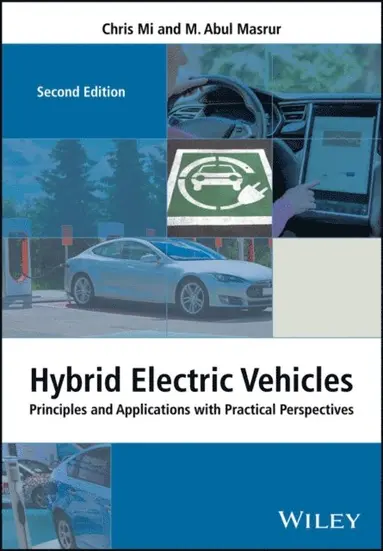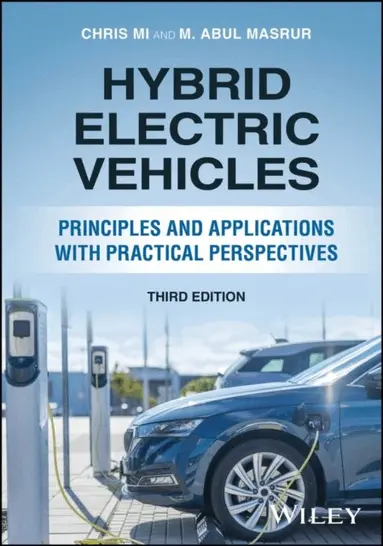
Hybrid Electric Vehicles
Principles and Applications with Practical Perspectives
1 093 kr
Tillfälligt slut. Bevaka för att få ett mejl när produkten kan beställas.
Fler format och utgåvor
Beskrivning
Produktinformation
- Utgivningsdatum:2011-05-04
- Språk:Engelska
- ISBN:9781119998914
- Förlag:John Wiley & Sons Inc
- Dimensioner:168 x 244 x 15 mm
Utforska kategorier
Mer om författaren
Chris Mi, University of Michigan; Abdul Masrur, US Army, David Gao, Tennessee TechDr. Chris Mi is Associate Professor of Electrical and Computer Engineering at the University of Michigan, Dearborn. His research interests are in power electronics, motor drives and electric and hybrid vehicles. He is the recipient of the "National Innovation Award", "Government Special Allowance" and "Distinguished Teaching Award" of University of Michigan, Dearborn. He is also a recipient of the 2007 IEEE Region 4 "Outstanding Engineer Award," 2007 "IEEE Southeastern Michigan Section Outstanding Professional Award," and 2007 SAE Environmental Excellence in Transportation (E2T) Award. Dr. Mi is the General Chair of IEEE Vehicle Power and Propulsion Conference (www.VPPC09.org).Dr. Abul Masrur works for the US Army RDECOM-TARDEC (Research Development & Engineering Command), in its Ground Vehicle Power & Mobility (GVPM) Department within TARDEC (Tank Automotive Research Development & Engineering Center), where for the past seven years he has been involved in vehicular electric power system architecture concept design, modeling and simulation, electric power management, and military applications. Prior to this, he worked for more than sixteen years with the Scientific Research Labs of the Ford Motor Co. Dr. Masrur also serves as an adjunct professor of Electrical & Computer Engineering at the University of Detroit on an advanced course related to vehicular electric power systems. He has authored more than sixty papers and has co-authored eight U.S. patents. He served as an Associate Editor, IEEE Transactions on Vehicular Technology, for eight years until September 2007. He received the Best Automotive Electronics Paper Award from the IEEE Vehicular Technology Society in 1998 for his papers in the IEEE Transactions on Vehicular Technology. He also received SAE International's Environmental Excellence in Transportation Award in Education, Training, & Public Awareness for a hybrid electric vehicle tutorial course. Dr. Masrur is currently the Chair of the Motor Subcommittee (MSC) under the Electric Machinery Committee, IEEE Power & Energy Society (PES).Dr. David W. Gao is currently an Assistant Professor of Electrical and Computer Engineering at Tennessee Tech University (TTU), teaching "Hybrid Electric Vehicle" at graduate-level. Previously he worked as an Assistant Research Professor in the University of South Carolina and Mississippi State University (MSU). He has published more than 30 papers in international journals and conference proceedings.
Innehållsförteckning
- About the Authors xiii Preface xvii1 Introduction 11.1 Sustainable Transportation 31.1.1 Population, Energy, and Transportation 41.1.2 Environment 51.1.3 Economic Growth 61.1.4 New Fuel Economy Requirement 71.2 A Brief History of HEVs 81.3 Why EVs Emerged and Failed in the 1990s, and What We Can Learn from It 101.4 Architectures of HEVs 111.4.1 Series HEVs 121.4.2 Parallel HEVs 131.4.3 Series–Parallel HEVs 141.4.4 Complex HEVs 151.4.5 Diesel Hybrids 151.4.6 Other Approaches to Vehicle Hybridization 161.4.7 Hybridization Ratio 161.5 Interdisciplinary Nature of HEVs 171.6 State of the Art of HEVs 181.6.1 The Toyota Prius 191.6.2 The Honda Civic 211.6.3 The Ford Escape 211.6.4 The Two-Mode Hybrid 211.7 Challenges and Key Technology of HEVs 221.8 The Invisible Hand–Government Support 23References 252 Concept of Hybridization of the Automobile 272.1 Vehicle Basics 272.1.1 Constituents of a Conventional Vehicle 272.1.2 Vehicle and Propulsion Load 272.1.3 Drive Cycles and Drive Terrain 302.2 Basics of the EV 312.2.1 Why EV? 312.2.2 Constituents of an EV 322.2.3 Vehicle and Propulsion Loads 342.3 Basics of the HEV 352.3.1 Why HEV? 352.3.2 Constituents of a HEV 352.4 Basics of Plug-In Hybrid Electric Vehicle (PHEV) 362.4.1 Why PHEV? 362.4.2 Constituents of a PHEV 372.4.3 Comparison between the HEV and PHEV 382.5 Basics of Fuel Cell Vehicles (FCVs) 382.5.1 Why FCV? 382.5.2 Constituents of a FCV 392.5.3 Some Issues Related to Fuel Cells 39Reference 393 HEV Fundamentals 413.1 Introduction 413.2 Vehicle Model 423.3 Vehicle Performance 443.4 EV Powertrain Component Sizing 473.5 Series Hybrid Vehicle 513.6 Parallel Hybrid Vehicle 563.6.1 Electrically Peaking Hybrid Concept 573.6.2 ICE Characteristics 633.6.3 Gradability Requirement 633.6.4 Selection of Gear Ratio from ICE to Wheel 643.7 Wheel Slip Dynamics 65References 674 Advanced HEV Architectures and Dynamics of HEV Powertrain 694.1 Principle of Planetary Gears 694.2 Toyota Prius and Ford Escape Hybrid Powertrain 724.3 GM Two-Mode Hybrid Transmission 764.3.1 Operating Principle of the Two-Mode Powertrain 764.3.2 Mode 0: Vehicle Launch and Backup 774.3.3 Mode 1: Low Range 784.3.4 Mode 2: High Range 794.3.5 Mode 3: Regenerative Braking 804.3.6 Transition from Mode 0 to Mode 3 804.4 Dual-Clutch Hybrid Transmissions 834.4.1 Conventional DCT Technology 844.4.2 Gear Shift Schedule 844.4.3 DCT-Based Hybrid Powertrain 854.4.4 Operation of DCT-Based Hybrid Powertrain 874.5 Hybrid Transmission Proposed by Zhang et al. 894.5.1 Motor-Alone Mode 904.5.2 Combined Power Mode 914.5.3 Engine-Alone Mode 914.5.4 Electric CVT Mode 914.5.5 Energy Recovery Mode 924.5.6 Standstill Mode 924.6 Renault IVT Hybrid Transmission 924.7 Timken Two-Mode Hybrid Transmission 934.7.1 Mode 0: Launch and Reverse 944.7.2 Mode 1: Low-Speed Operation 944.7.3 Mode 2: High-Speed Operation 944.7.4 Mode 4: Series Operating Mode 944.7.5 Mode Transition 964.8 Tsai’s Hybrid Transmission 964.9 Hybrid Transmission with Both Speed and Torque Coupling Mechanism 984.10 Toyota Highlander and Lexus Hybrid, E-Four-Wheel Drive 994.11 CAMRY Hybrid 1014.12 Chevy Volt Powertrain 1024.13 Dynamics of Planetary-Based Transmissions 1034.13.1 Non-ideal Gears in the Planetary System 1034.13.2 Dynamics of the Transmission 1044.14 Conclusions 105References 1065 Plug-in Hybrid Electric Vehicles 1075.1 Introduction to PHEVs 1075.1.1 PHEVs and EREVs 1075.1.2 Blended PHEVs 1085.1.3 Why PHEV? 1085.1.4 Electricity for PHEV Use 1105.2 PHEV Architectures 1105.3 Equivalent Electric Range of Blended PHEVs 1125.4 Fuel Economy of PHEVs 1125.4.1 Well-to-Wheel Efficiency 1135.4.2 PHEV Fuel Economy 1135.4.3 Utility Factor 1145.5 Power Management of PHEVs 1155.6 PHEV Design and Component Sizing 1185.7 Component Sizing of EREVs 1195.8 Component Sizing of Blended PHEVs 1195.9 HEV to PHEV Conversions 1205.9.1 Replacing the Existing Battery Pack 1205.9.2 Adding an Extra Battery Pack 1225.9.3 Converting Conventional Vehicles to PHEVs 1235.10 Other Topics on PHEVs 1235.10.1 End-of-Life Battery for Electric Power Grid Support 1235.10.2 Cold Start Emissions Reduction in PHEVs 1235.10.3 Cold Weather/Hot Weather Performance Enhancement in PHEVs 1245.10.4 PHEV Maintenance 1245.10.5 Safety of PHEVs 1245.11 Vehicle-to-Grid Technology 1255.11.1 PHEV Battery Charging 1265.11.2 Impact of G2V 1265.11.3 The Concept of V2G 1295.11.4 Advantages of V2G 1345.11.5 Case Studies of V2G 1345.12 Conclusion 136References 1386 Special Hybrid Vehicles 1396.1 Hydraulic Hybrid Vehicles 1396.1.1 Regenerative Braking in HHVs 1426.2 Off-road HEVs 1446.3 Diesel HEVs 1496.4 Electric or Hybrid Ships, Aircraft, Locomotives 1506.4.1 Ships 1506.4.2 Aircraft 1546.4.3 Locomotives 1566.5 Other Industrial Utility Application Vehicles 159References 160Further Reading 1607 HEV Applications for Military Vehicles 1637.1 Why HEVs Can Be Beneficial to Military Applications 1637.2 Ground Vehicle Applications 1647.2.1 Architecture – Series, Parallel, Complex 1647.2.2 Vehicles Which Are of Most Benefit 1667.3 Non-ground Vehicle Military Applications 1687.3.1 Electromagnetic Launchers 1697.3.2 Hybrid-Powered Ships 1707.3.3 Aircraft Applications 1717.3.4 Dismounted Soldier Applications 1717.4 Ruggedness Issues 173References 174Further Reading 1758 Diagnostics, Prognostics, Reliability, EMC, and Other Topics Related to HEVs 1778.1 Diagnostics and Prognostics in HEVs and EVs 1778.1.1 Onboard Diagnostics 1788.1.2 Prognostics Issues 1808.2 Reliability of HEVs 1828.2.1 Analyzing the Reliability of HEV Architectures 1838.2.2 Reliability and Graceful Degradation 1858.2.3 Software Reliability Issues 1878.3 EMC Issues 1908.4 Noise Vibration Harshness (NVH), Electromechanical, and Other Issues 1928.5 End-of-Life Issues 194References 195Further Reading 1959 Power Electronics in HEVs 1979.1 Introduction 1979.2 Principle of Power Electronics 1989.3 Rectifiers Used in HEVs 2009.3.1 Ideal Rectifier 2009.3.2 Practical Rectifier 2019.3.3 Single-Phase Rectifier 2029.3.4 Voltage Ripple 2049.4 Buck Converter Used in HEVs 2079.4.1 Operating Principle 2079.4.2 Nonlinear Model 2089.5 Non-isolated Bidirectional DC–DC Converter 2099.5.1 Operating Principle 2099.5.2 Maintaining Constant Torque Range and Power Capability 2119.5.3 Reducing Current Ripple in the Battery 2129.5.4 Regenerative Braking 2139.6 Voltage Source Inverter 2139.7 Current Source Inverter 2139.8 Isolated Bidirectional DC–DC Converter 2179.8.1 Basic Principle and Steady State Operations 2189.8.2 Voltage Ripple 2229.9 PWM Rectifier in HEVs 2269.9.1 Rectifier Operation of Inverter 2269.10 EV and PHEV Battery Chargers 2299.10.1 Forward/Flyback Converters 2309.10.2 Half-Bridge DC–DC Converter 2319.10.3 Full-Bridge DC–DC Converter 2319.10.4 Power Factor Correction Stage 2329.10.5 Bidirectional Battery Chargers 2349.10.6 Other Charger Topologies 2349.10.7 Inductive Charging 2359.10.8 Wireless Charging 2369.11 Modeling and Simulation of HEV Power Electronics 2379.11.1 Device-Level Simulation 2389.11.2 System-Level Model 2399.12 Emerging Power Electronics Devices 2399.13 Circuit Packaging 2409.14 Thermal Management of HEV Power Electronics 2409.15 Conclusions 243References 24310 Electric Machines and Drives in HEVs 24510.1 Introduction 24510.2 Induction Motor Drives 24610.2.1 Principle of Induction Motors 24610.2.2 Equivalent Circuit of Induction Motor 24810.2.3 Speed Control of Induction Machine 25010.2.4 Variable Frequency, Variable Voltage Control of Induction Motors 25210.2.5 Efficiency and Losses of Induction Machine 25310.2.6 Additional Loss in Induction Motors due to PWM Supply 25410.2.7 Field-Oriented Control of Induction Machine 26510.3 Permanent Magnet Motor Drives 27110.3.1 Basic Configuration of PM Motors 27210.3.2 Basic Principle and Operation of PM Motors 27310.3.3 Magnetic Circuit Analysis of IPM Motors 27710.3.4 Sizing of Magnets in PM Motors 28610.3.5 Eddy Current Losses in the Magnets of PM Machines 29110.4 Switched Reluctance Motors 29110.5 Doubly Salient Permanent Magnet Machines 29310.6 Design and Sizing of Traction Motors 29710.6.1 Selection of A and B 29810.6.2 Speed Rating of the Traction Motor 29810.6.3 Determination of the Inner Power 29910.7 Thermal Analysis and Modeling of Traction Motors 29910.8 Conclusions 306References 30611 Batteries, Ultracapacitors, Fuel Cells, and Controls 31511.1 Introduction 31511.2 Battery Characterization 31711.3 Comparison of Different Energy Storage Technologies for HEVs 32111.4 Modeling Based on Equivalent Electric Circuits 32511.4.1 Battery Modeling 32511.4.2 Battery Modeling Example 32711.4.3 Modeling of Ultracapacitors 32911.4.4 Battery Modeling Example for Hybrid Battery and Ultracapacitor 33111.5 Battery Charging Control 33411.6 Charge Management of Storage Devices 33711.7 Flywheel Energy Storage System 34111.8 Hydraulic Energy Storage System 34411.9 Fuel Cells and Hybrid Fuel Cell Energy Storage System 34511.9.1 Introduction to Fuel Cells 34511.9.2 Fuel Cell Modeling 34911.9.3 Hybrid Fuel Cell Energy Storage Systems 35211.9.4 Control Strategy of Hybrid Fuel Cell Power System 35511.10 Summary and Discussion 360References 36112 Modeling and Simulation of Electric and Hybrid Vehicles 36312.1 Introduction 36312.2 Fundamentals of Vehicle System Modeling 36412.3 HEV Modeling Using ADVISOR 36612.4 HEV Modeling Using PSAT 36912.5 Physics-Based Modeling 37012.6 Bond Graph and Other Modeling Techniques 37812.7 Consideration of Numerical Integration Methods 38112.8 Conclusion 382References 38213 HEV Component Sizing and Design Optimization 38513.1 Introduction 38513.2 Global Optimization Algorithms for HEV Design 38613.2.1 DIRECT 38613.2.2 Simulated Annealing 39113.2.3 Genetic Algorithms 39313.2.4 Particle Swarm Optimization 39513.2.5 Advantages/Disadvantages of Different Optimization Algorithms 39813.3 Model-in-the-Loop Design Optimization Process 39913.4 Parallel HEV Design Optimization Example 40013.5 Series HEV Design Optimization Example 40513.5.1 Control Framework of a series HEV Powertrain 40513.5.2 Series HEV Parameter Optimization 40713.5.3 Optimization Results 40813.6 Conclusion 410References 41214 Vehicular Power Control Strategy and Energy Management 41314.1 A Generic Framework, Definition, and Needs 41314.2 Methodology to Implement 41514.2.1 Methodologies for Optimization 42014.2.2 Cost Function Optimization 42314.3 Benefits of Energy Management 428References 429Further Reading 42915 Commercialization and Standardization of HEV Technology and Future Transportation 43115.1 What Is Commercialization and Why Is It Important for HEVs? 43115.2 Advantages, Disadvantages, and Enablers of Commercialization 43115.3 Standardization and Commercialization 43215.4 Commercialization Issues and Effects on Various Types of Vehicles 43315.5 Commercialization and Future of HEVs and Transportation 434Further Reading 434Index 435
Mer från samma författare
Wireless Power Transfer for Electric Vehicles and Mobile Devices
Chris Mi, Chun T. Rim
1 662 kr
Wireless Power Transfer for Electric Vehicles and Mobile Devices
Chris Mi, Chun T. Rim
1 650 kr
Du kanske också är intresserad av
Trends in Green Energy Transition for Sustainable Energy Systems
Pradeep Kumar, S. N. Singh, David Wenzhong Gao
Inbunden, 2027
3 009 kr