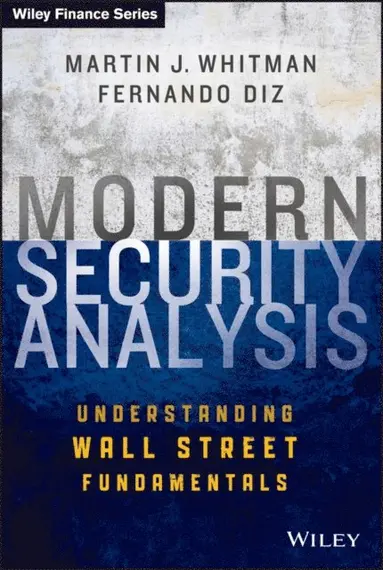
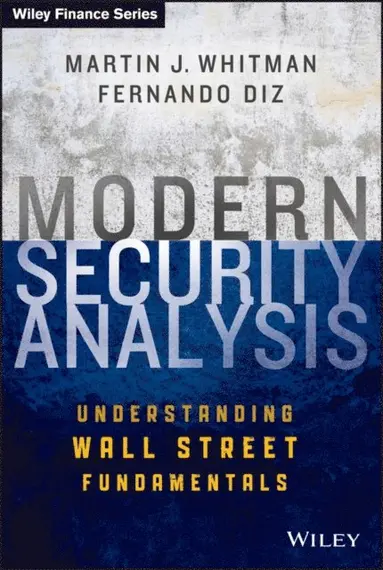
Modern Security Analysis
Understanding Wall Street Fundamentals
742 kr
Beställningsvara. Skickas inom 3-6 vardagar. Fri frakt över 249 kr.
Beskrivning
Produktinformation
- Utgivningsdatum:2013-05-20
- Mått:155 x 231 x 41 mm
- Vikt:748 g
- Format:Inbunden
- Språk:Engelska
- Serie:Wiley Finance
- Antal sidor:496
- Förlag:John Wiley & Sons Inc
- ISBN:9781118390047
Utforska kategorier
Mer om författaren
MARTIN J. WHITMAN is Chairman of the Third Avenue Funds and founder of Third Avenue Management, an investment adviser to private and institutional clients. Mr. Whitman has proven for more than fifty years that active, opportunistic investors can find under-priced securities in companies with strong balance sheets. He is also an adept control investor who was an important participant in the rehabilitation of Nabors Industries and Covanta Energy, among others. He was Third Avenue's Chief Investment Officer from its founding through January 2010. For over thirty years, Mr. Whitman was a Distinguished Management Fellow at the Yale School of Management. He is also an honorary trustee at Syracuse University which is also home to the Whitman School of Management. He is a frequent speaker and commentator within the financial services community. FERNANDO DIZ is the Managing Director of the Orange Value Fund, LLC, the Martin J. Whitman Professor of Finance and the Director of the Ballentine Investment Institute at Syracuse University. He teaches classes in value, control and distress investing and created and directs the two-year Orange Value Fund program. He is the co-author with Martin J. Whitman of Distress Investing: Principles and Technique. Professor Diz received his MSc and PhD degrees from Cornell University.
Recensioner i media
“Modern Security Analysis is full of useful discussions of such standard topics as creditworthiness, market efficiency, diversification, and financial accounting. But it also includes descriptions of more controversial ideas about the overriding importance of tangible net asset value, the shortcomings of the Graham–Dodd approach to value investing, and the irrelevance of both modern capital theory and broker/dealer research.”—CFA Institute Book Review
Innehållsförteckning
- Acknowledgments xvIntroduction 1Part One The Foundations of Modern Business and Security Analysis 9Chapter 1 The Scope of Fundamental Finance, Investing, and the Investor Landscape 11Investing versus Speculating 12The OPMI Defined 17Activists 18Summary 18Chapter 2 A Short Introduction to the Going Concern and Resource Conversion Views of Businesses 19Methods of Wealth Creation 20The Pure Going Concern View 21The Resource Conversion View 23Summary 25Chapter 3 Substantive Consolidation and Structural Subordination 27Substantive Consolidation Not of Prime Importance 29The Accounting for Stock Options Controversy in Light of the Substantive Consolidation Doctrine 32Structural Subordination Not a Significant Factor 37Lack of Progress in Eurozone Crisis Resolution: The Failure to Use Substantive Consolidation 40Summary 41Chapter 4 The Substantive Characteristics of Securities 43Types of Securities for Analytic Purposes 44Control versus Non-Control Securities 44Control and Non-Control Pricing and Arbitrage 45Terms of Securities as Options 49What a Security is Depends on Where You Sit 50Summary 55Chapter 5 Primacy of the Income Account or Wealth Creation? What are Earnings, Anyway? 57Wealth or Earnings? 59Influence of Reported Earnings on Common Stock Prices 61The Long-Term Earnings Record 63Parsing the Income Account 64Summary 68Chapter 6 Net Asset Value: The Static and Dynamic Views 69The Graham and Dodd View on NAV 71The Financial Accounting View on NAV 72Our View on NAV 73The Usefulness of NAV in Security Analysis 75The Importance of NAV Dynamics 78NAV as One Measure of Resources 83NAV as One Measure of Potential Liquidity 84Limitations of NAV in Security Analyses 89Large Premiums over Book Value Always Mean High P/E Ratios: It Depends on ROE 93Net Nets Redefined 94OPMI Investing in Companies with Growing NAVs 96Summary 101Chapter 7 Creditworthiness 103Creditworthiness from the Borrowing Entity Point of View 105Capital Structure 107Capital Structure from the Corporate Perspective 107Factors Affecting Capital Structure 112Conservative Capital Structures 117Summary 118Chapter 8 What Matters is Investment Risk 119There is No General Risk—Only Specific Risk 120The Components of Investment Risk 122Successful People Avoid Investment Risk 123Methods to Avoid Investment Risk 125Safe and Cheap Investing and Minimizing Investment Risk 127Summary 130Chapter 9 Shareholder Distributions from the Company Point of View 131Cash Dividends or Retained Earnings 132Stock Dividends 135Stock Repurchases 138Distribution of Assets Other than Cash 141Liquidation 141Summary 142Chapter 10 Roles of Cash Dividends in Security Analysis and Portfolio Management 143The Three Conventional Theories 145Cash Dividends as a Factor in Market Performance 149The Placebo Effect of Cash Dividends 151Cash Dividends and Portfolio Management 151Cash Dividends and Legal Lists 154Cash Dividends and Bailouts 154The Goals of Securities Holders 156Summary 157Chapter 11 The Appraisal of Managements and Growth: GARP versus GADCP 159New Framework for the Appraisal of Managements 160Managements Attuned to OPMI Interests 161Managements as Resource Converters 162Tradeoffs 165Growth: GARP versus GADCP 166Growth at a Reasonable Price (GARP) 167Growth at Dirt Cheap Prices (GADCP) 168Summary 170Chapter 12 The Significance (or Lack of Significance) of Market Performance 173Market Performance and the Character of a Portfolio 176Market Performance of Portfolios versus Individual Securities 177Outsiders, Insiders, and Market Price 179Professional Money Managers and Beating the Market 180Perspective on Bailouts and the Significance of Market Performance 181Summary 182Chapter 13 How Much Diversification? 185Portfolio Diversification versus Securities Concentration 186Corporate Diversification versus Concentration 190Summary 191Chapter 14 Toward a General Theory of Market Efficiency 193The Determinants of Market Efficiency 195External Forces Influencing Markets Explained 198Great Economists Can Learn a Lot from Value Investors 199Markets Where External Disciplines Seem to Be Lacking 206Market Efficiency and Fair Prices in Takeovers 211Summary 213Part Two Putting It All Together: Safe and Cheap Investing versus Conventional Approaches 215Chapter 15 Safe and Cheap Investing 217The Safe and Cheap Approach 218Benefits of the Safe and Cheap Approach for the OPMI 220Restrictions and Demands of the Safe and Cheap Approach 222Summary 231Chapter 16 Graham and Dodd Placed in Context 233The OPMI Defined 235The OPMI Perspective of Analysis 236The Going Concern and Investment Company Views of Businesses 238Primacy of the Income Account and Wealth Creation 238Primacy of the Income Account, Dividends, and Corporate Uses of Cash 240Primacy of the Income Account and the Appraisal of Managements 240Primacy of the Income Account and Top-Down versus Bottom-Up Analysis 241Primacy of the Income Account and Diversification 241Primacy of the Income Account and Growth Stocks 242Market Risk versus Investment Risk and Margin of Safety 242The Importance of Market Performance 243Uses and Limitations of Financial Accounting 244Substantive Consolidation 245Compensation of Promoters 245Do Stock Market Prices Reflect Corporate Values? 245Trade-Offs 247Modern Capital Theory versus Graham and Dodd 247Summary 248Chapter 17 Academic Finance: Modern Capital Theory 249The MCT Point of View 253Equilibrium Pricing is Universally Applicable 254The Outside Passive Minority Investor is the Only Relevant Market 260Diversification is a Necessary Protection against Unsystematic Risk 261Systematic Risk Exists 262Value is Determined by Forecasts of Discounted Cash Flows 262Companies are Analyzed Basically as Going Concerns; Investors in Marketable Securities are Analyzed as Investment Companies 264Investors are Monolithic: Their Unitary Goal is Risk-Adjusted Total Return, Earned Consistently 266Market Efficiency Means an Absence of Market Participants Who Earn Excess Returns Consistently or Persistently 267General Laws are Important 269Risk is Defined as Market Risk 271Macro Considerations are Important 272Creditor Control is a Nonissue 273Transaction Costs are a Nonissue 273Free Markets are Better than Regulated Markets 273The Outside Passive Minority Investor Market is Better Informed than Any Individual Investor 275Markets are Efficient or at Least Tend Toward an Instantaneous Efficiency 275Summary 276Chapter 18 Broker-Dealer Research Departments and Conventional Money Managers 277How Research Departments and Conventional Money Managers Think 279Problems Faced by Research Departments and Conventional Money Managers 282Summary 292Part Three Real-World Considerations 295Chapter 19 Uses and Limitations of Financial Accounting 297The Conventional Approaches 299Financial Accounting Reports as Objective Benchmarks 302Generally Accepted Accounting Principles as Defining Reality for Certain Specific Purposes 309Generally Accepted Accounting Principles as a Road Map for Due Diligence and Less Thorough Investigations 310Summary 319Chapter 20 Company Disclosures and Information: Following the Paper Trail in the United States 321Narrative Disclosures in the United States 322The Documents and How to Read Them 327What the Paper Trail Does for the Outside Investor 328What the Paper Trail Doesn’t Do 331How Good is the Paper Trail? 334Summary 335Chapter 21 Buying Securities in Bulk 337Methods for Acquisition of Common Stocks 338Acquisition of Voting Equities through Exchanges of Securities 343Acquisition of Control without Acquiring Securities by Using the Proxy Machinery 345Summary 346Part Four Understanding Resource Conversion 347Chapter 22 A Short Primer on Resource Conversion 349Long-Term Arbitrage between OPMI Prices and Control Values 350More Aggressive Employment of Existing Assets 355Merger and Acquisition Activity 355Corporate Contests for Control 356Going Private and Leveraged Buyouts 359Summary 368Chapter 23 Restructuring Troubled Companies 369The Five Basic Truths of Distress Investing 370Rehabilitation of Troubled Entities 380Summary 391Chapter 24 The Role of Government in Reorganizations 393Bailouts or Capital Infusions? 394Too Big to Fail is a Phony Concept 395The Government and Private Sector are in Partnership Whether They Like It or Not 396Wall Street Professionals and Corporate Executives are All in the Business of Creating Moral Hazards 398Taxpayer Bailouts are a Phony Concept 398A Revolution in Corporate Reorganizations and Liquidations May Have Occurred in 2009 with the Chapter 11 Reorganizations of General Motors, Chrysler, and CIT Corporation 399Strict Regulation of Financial Institutions is Absolutely Necessary 399Summary 400Part Five Active Investors Buy and Sell Common Stocks on an Advantageous Basis 401Chapter 25 The Economics of Private Equity Leveraged Buyouts 403The 2005 Acquisition of Hertz Global Holdings and Subsequent Events as a Prime Example 404Super-Attractive Access to Capital Markets 404Cash Payments to Sponsors and Sponsor-Controlled Funds 409Sponsors’ Control of Hertz 410Sponsors Attuned to the Needs of Bankers and the Wall Street Underwriting Community 411Questions about LBOs 412Summary 413Chapter 26 The Use of Creative Finance in a Corporate Takeover 415The Case 415The Postscript 427Investment Lessons 428The Appraisal of Management 430Spotting Doable Deals 431Summary 432Chapter 27 The Use of Creative Finance to Benefit Controlling Stockholders 433The Problems Faced in the Schaefer Corporation Deal 435The Background of the Deal 435Discount Purchases of Restricted Corporate Stock 437Corporation’s Acquisition of Brewing 440Problems and Wealth Creation Potentials for the Parties in Interest 449Summary 467Glossary of Acronyms 469About the Authors 471Index 473
Mer från samma serie
Valuation: Measuring and Managing the Value of Companies, University Edition
Tim Koller, Marc Goedhart, David Wessels
Häftad, 2025
1 045 kr
Quantitative Momentum
Wesley R. Gray, Jack R. Vogel
Häftad, 2025
178 kr
Financial Risk Manager Handbook, + Test Bank
Philippe Jorion, GARP (Global Association of Risk Professionals)
Häftad, 2010
1 979 kr
Du kanske också är intresserad av
- Nyhet
Proceedings of 2021 International Conference on Autonomous Unmanned Systems (ICAUS 2021)
Meiping Wu, Yifeng Niu, Mancang Gu, Jin Cheng
8 311 kr