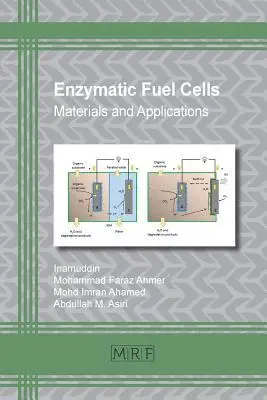
Enzymatic Fuel Cells
From Fundamentals to Applications
AvHeather R. Luckarift,Plamen B. Atanassov
1 592 kr
Beställningsvara. Skickas inom 11-20 vardagar. Fri frakt över 249 kr.
Fler format och utgåvor
Beskrivning
Produktinformation
- Utgivningsdatum:2014-05-27
- Mått:165 x 244 x 31 mm
- Vikt:857 g
- Format:Inbunden
- Språk:Engelska
- Antal sidor:496
- Förlag:John Wiley & Sons Inc
- ISBN:9781118369234
Utforska kategorier
Mer om författaren
HEATHER R. LUCKARIFT is the Senior Research Scientist for Universal Technology Corporation at the Air Force Civil Engineer Center (formerly the Microbiology & Applied Biochemistry team at the Air Force Research Laboratory). She is the author of over fifty peer-reviewed publications and invited reviews.PLAMEN ATANASSOV is a Professor of Chemical & Nuclear Engineering and the founding director of The University of New Mexico Center for Emerging Energy Technologies. He was the principal investigator on an Air Force Office of Scientific Research Multi-University Research Initiative program: “Fundamentals and Bioengineering of Enzymatic Fuel Cells.” He is the author of more than 220 publications, including twelve reviews.GLENN R. JOHNSON is the Chief Scientist and founder of Hexpoint Technologies and the former principal investigator of the Microbiology & Applied Biochemistry team within the Air Force Research Laboratory. He is the author of over fifty peer-reviewed publications and invited reviews.
Innehållsförteckning
- Preface xvContributors xvii1 Introduction 1Heather R. Luckarift, Plamen Atanassov, and Glenn R. JohnsonList of Abbreviations 32 Electrochemical Evaluation of Enzymatic Fuel Cells and Figures of Merit 4Shelley D. Minteer, Heather R. Luckarift, and Plamen Atanassov2.1 Introduction 42.2 Electrochemical Characterization 52.3 Outlook 9Acknowledgment 10List of Abbreviations 10References 103 Direct Bioelectrocatalysis: Oxygen Reduction for Biological Fuel Cells 12Dmitri M. Ivnitski, Plamen Atanassov, and Heather R. Luckarift3.1 Introduction 123.2 Mechanistic Studies of Intramolecular Electron Transfer 133.3 Achieving DET of MCO by Rational Design 183.4 Outlook 25Acknowledgments 26List of Abbreviations 26References 274 Anodic Catalysts for Oxidation of Carbon-Containing Fuels 33Rosalba A. Rincón, Carolin Lau, Plamen Atanassov, and Heather R. Luckarift4.1 Introduction 334.2 Oxidases 344.3 Dehydrogenases 354.4 PQQ-Dependent Enzymes 424.5 Outlook 44Acknowledgment 45List of Abbreviations 45References 455 Anodic Bioelectrocatalysis: From Metabolic Pathways to Metabolons 53Shuai Xu, Lindsey N. Pelster, Michelle Rasmussen, and Shelley D. Minteer5.1 Introduction 535.2 Biological Fuels 535.3 Promiscuous Enzymes Versus Multienzyme Cascades Versus Metabolons 555.4 Direct and Mediated Electron Transfer 575.5 Fuels 585.6 Outlook 72Acknowledgment 72List of Abbreviations 73References 736 Bioelectrocatalysis of Hydrogen Oxidation/Reduction by Hydrogenases 80Anne K. Jones, Arnab Dutta, Patrick Kwan, Chelsea L. McIntosh, Souvik Roy, and Sijie Yang6.1 Introduction 806.2 Hydrogenases 816.3 Biological Fuel Cells Using Hydrogenases: Electrocatalysis 856.4 Electrocatalysis by Functional Mimics of Hydrogenases 926.5 Outlook 97Acknowledgments 98List of Abbreviations 98References 997 Protein Engineering for Enzymatic Fuel Cells 109Elliot Campbell and Scott Banta7.1 Engineering Enzymes for Catalysis 1097.2 Engineering Other Properties of Enzymes 1127.3 Enzyme Immobilization and Self-Assembly 1157.4 Artificial Metabolons 1177.5 Outlook 118List of Abbreviations 118References 1188 Purification and Characterization of Multicopper Oxidases for Enzyme Electrodes 123D. Matthew Eby and Glenn R. Johnson8.1 Introduction 1238.2 General Considerations for MCO Expression and Purification 1248.3 MCO Production and Expression Systems 1258.4 MCO Purification 1288.5 Copper Stability and Specific Considerations for MCO Production 1338.6 Spectroscopic Monitoring and Characterization of Copper Centers 1368.7 Outlook 139Acknowledgment 140List of Abbreviations 140References 1409 Mediated Enzyme Electrodes 146Joshua W. Gallaway9.1 Introduction 1469.2 Fundamentals 1479.3 Types of Mediation 1529.4 Aspects of Mediator Design I: Mediator Overpotentials 1629.5 Aspects of Mediator Design II: Saturated Mediator Kinetics 1659.6 Outlook 172List of Abbreviations 172References 17210 Hierarchical Materials Architectures for Enzymatic Fuel Cells 181Guinevere Strack and Glenn R. Johnson10.1 Introduction 18110.2 Carbon Nanomaterials and the Construction of the Bio–Nano Interface 18410.3 Biotemplating: The Assembly of Nanostructured Biological–Inorganic Materials 19110.4 Fabrication of Hierarchically Ordered 3D Materials for Enzyme and Microbial Electrodes 19410.5 Incorporating Conductive Polymers into Bioelectrodes for Fuel Cell Applications 19810.6 Outlook 201Acknowledgment 201List of Abbreviations 201References 20211 Enzyme Immobilization for Biological Fuel Cell Applications 208Lorena Betancor and Heather R. Luckarift11.1 Introduction 20811.2 Immobilization by Physical Methods 20911.3 Entrapment as a Pre- and Post-Immobilization Strategy 21111.4 Enzyme Immobilization via Chemical Methods 21311.5 Orientation Matters 21611.6 Outlook 218Acknowledgment 219List of Abbreviations 219References 21912 Interrogating Immobilized Enzymes in Hierarchical Structures 225Michael J. Cooney and Heather R. Luckarift12.1 Introduction 22512.2 Estimating the Bound Active (Redox) Enzyme 22712.3 Probing the Distribution of Immobilized Enzyme Within Hierarchical Structures 23212.4 Probing the Immediate Chemical Microenvironments of Enzymes in Hierarchical Structures 23512.5 Enzyme Aggregation in a Hierarchical Structure 23612.6 Outlook 238Acknowledgment 239List of Abbreviations 239References 23913 Imaging and Characterization of the Bio–Nano Interface 242Karen E. Farrington, Heather R. Luckarift, D. Matthew Eby, and Kateryna Artyushkova13.1 Introduction 24213.2 Imaging the Bio–Nano Interface 24313.3 Characterizing the Bio–Nano Interface 24813.4 Interrogating the Bio–Nano Interface 25613.5 Outlook 267Acknowledgment 267List of Abbreviations 267References 26814 Scanning Electrochemical Microscopy for Biological Fuel Cell Characterization 273Ramaraja P. Ramasamy14.1 Introduction 27314.2 Theory and Operation 27414.3 Ultramicroelectrodes 27514.4 Modes of SECM Operation 27814.5 SECM for BFC Anodes 28114.6 SECM for BFC Cathodes 28514.7 Catalyst Screening Using SECM 29014.8 SECM for Membranes 29114.9 Probing Single Enzyme Molecules Using SECM 29314.10 Combining SECM with Other Techniques 29314.11 Outlook 297List of Abbreviations 297References 29815 In Situ X-Ray Spectroscopy of Enzymatic Catalysis: Laccase-Catalyzed Oxygen Reduction 304Sanjeev Mukerjee, Joseph Ziegelbauer, Thomas M. Arruda, Kateryna Artyushkova, and Plamen Atanassov15.1 Introduction 30415.2 Defining the Enzyme/Electrode Interface 30515.3 Direct Electron Transfer Versus Mediated Electron Transfer 30615.4 The Blue Copper Oxidases 30815.5 In Situ XAS 31015.6 Proposed ORR Mechanism 32715.7 Outlook 331Acknowledgments 331List of Abbreviations 331References 33216 Enzymatic Fuel Cell Design, Operation, and Application 337Vojtech Svoboda and Plamen Atanassov16.1 Introduction 33716.2 Biobatteries and EFCs 33816.3 Components 33916.4 Single-Cell Design 34516.5 Microfluidic EFC Design 34816.6 Stacked Cell Design 34816.7 Bipolar Electrodes 35016.8 Air/Oxygen Supply 35116.9 Fuel Supply 35116.10 Storage and Shelf Life 35616.11 EFC Operation, Control, and Integration with Other Power Sources 35616.12 EFC Control 35716.13 Power Conditioning 35716.14 Outlook 358List of Abbreviations 359References 35917 Miniature Enzymatic Fuel Cells 361Takeo Miyake and Matsuhiko Nishizawa17.1 Introduction 36117.2 Insertion MEFC 36217.3 Microfluidic MEFC 36617.4 Flexible Sheet MEFC 37017.5 Outlook 371List of Abbreviations 372References 37218 Switchable Electrodes and Biological Fuel Cells 374Evgeny Katz, Vera Bocharova, and Jan Halámek18.1 Introduction 37418.2 Switchable Electrodes for Bioelectronic Applications 37518.3 Light-Switchable Modified Electrodes Based on Photoisomerizable Materials 37618.4 Magnetoswitchable Electrochemical Reactions Controlled by Magnetic Species Associated with Electrode Interfaces 37818.5 Modified Electrodes Switchable by Applied Potentials Resulting in Electrochemical Transformations at Functional Interfaces 38118.6 Chemically/Biochemically Switchable Electrodes 38318.7 Coupling of Switchable Electrodes with Biomolecular Computing Systems 38918.8 BFCs with Switchable/Tunable Power Output 39618.9 Outlook 412Acknowledgments 413List of Abbreviations 413References 41419 Biological Fuel Cells for Biomedical Applications 422Magnus Falk, Sergey Shleev, Claudia W. Narváez Villarrubia, Sofia Babanova, and Plamen Atanassov19.1 Introduction 42219.2 Definition and Classification of BFCs 42419.3 Design Aspects of EFCs 42719.4 In Vitro and In Vivo BFC Studies 43319.5 Outlook 440List of Abbreviations 442References 44320 Concluding Remarks and Outlook 451Glenn R. Johnson, Heather R. Luckarift, and Plamen Atanassov20.1 Introduction 45120.2 Primary System Engineering: Design Determinants 45320.3 Fundamental Advances in Bioelectrocatalysis 45420.4 Design Opportunities from EFC Operation 45420.5 Fundamental Drivers for EFC Miniaturization 45520.6 Commercialization of EFCs: Strategies and Opportunities 455Acknowledgment 457List of Abbreviations 457References 457Index 459
Du kanske också är intresserad av
- Nyhet
- Signerad!
- Nyhet
- Nyhet
Systrarna på Sophiahemmet
Ruth Kvarnström-Jones
Inbunden, 2026
239 kr
- -15%