
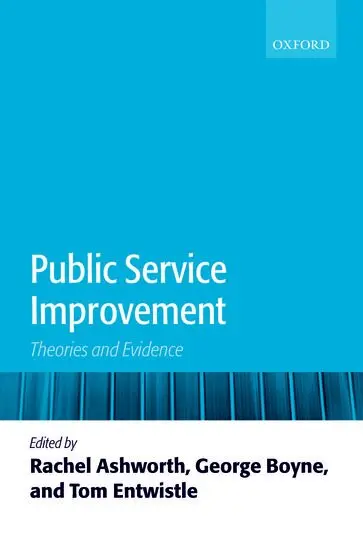
Public Service Improvement
Rachel E. Ashworth, George A. Boyne, Tom Entwistle, Rachel Ashworth, George Boyne, Tom Entwistle
Häftad, 2010
1 089 kr
473 kr
Kommande. Bevaka för att få ett mejl när produkten kan beställas.
Rachel E. Ashworth, George A. Boyne, Tom Entwistle, Rachel Ashworth, George Boyne, Tom Entwistle
Häftad, 2010
1 089 kr

Eric Cornuel, Howard Thomas, Matthew Wood
Häftad, 2026
508 kr

Eric Cornuel, Howard Thomas, Matthew Wood
Inbunden, 2022
796 kr

Eric Cornuel, Howard Thomas, Matthew Wood
Inbunden, 2023
751 kr



Eric Cornuel, Nicola Kleyn, Howard Thomas, Matthew Wood
Inbunden, 2025
751 kr

Eric Cornuel, Howard Thomas, Matthew Wood
Inbunden, 2022
796 kr
Eric Cornuel, Nicola Kleyn, Howard Thomas, Matthew Wood
Inbunden, 2025
751 kr
Eric Cornuel, Howard Thomas, Matthew Wood
Häftad, 2026
508 kr

Eric Cornuel, Howard Thomas, Matthew Wood
Inbunden, 2023
751 kr


Anna Blennow, Alexandra Borg, Stina Otterberg Engdahl, Johan Fredrikzon, Thomas Götselius, Birgitta Holm, Nils Håkanson, Magnus Källström, Jila Mossaed, Daniel Pedersen, Tapani Ritamäki, Ola Wikander
Inbunden, 2027
265 kr

Julie Davies, Howard Thomas, Eric Cornuel, Rolf D. Cremer
Häftad, 2023
494 kr