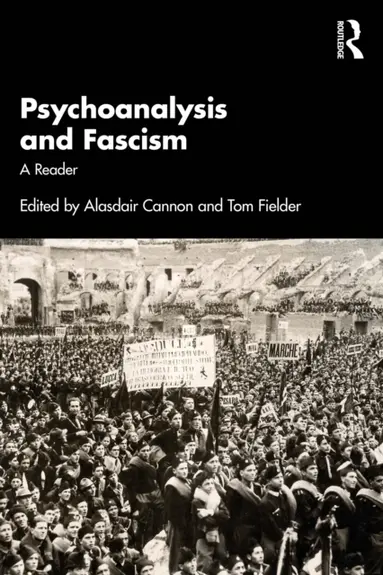
“In the present conjuncture, authoritarianism has spread across the world and fascism is looming. How can we understand the appeal of these destructive trends and begin to oppose them? In this inspiring Reader, Alasdair Cannon and Tom Fielder provide some essential texts bringing psychoanalysis to bear on these questions. Their own Introduction and Conclusion draws this material together into a powerful new account of the dynamics of fascism (the ‘fascist state of fantasy’) that sets the agenda for political and psychoanalytic resistance. This is an essential text for a deeply troubling world.”Stephen Frosh, Emeritus Professor, Birkbeck, University of London, UK“Against the backdrop of contemporary political culture, Alasdair Cannon and Tom Fielder’s excellent Reader provides an important contribution to the field of psychopolitics at a time when authoritarian leaders, far-right populism, and processes of radicalisation are widespread. The book brings together significant texts drawing on a range of perspectives and traditions, past and present, addressing the interweaving of conscious and unconscious forces that underlie the pull of fascism and how to resist it. The authors’ substantial introduction and conclusion reflect critically on the essays in this volume, providing original insights into fascism as a ‘multi-dimensional psychosocial phenomenon’ shaped by ‘fascist states of fantasy.’ This is urgent work: as forces associated with fascism reassert themselves across the political landscape, the task of understanding and countering their psychic hold has rarely felt more pressing, and this book offers vital resources for that task.”Candida Yates, Emerita Professor, Bournemouth University, UK“This is not simply a book about fascism; it is a profound exploration of the vulnerabilities of the human mind, the fragility of democratic life, and the psychic conditions that render cruelty, exclusion, and dehumanization imaginable. At a moment when authoritarian fantasies are once again gaining political traction, this volume demonstrates that understanding these processes is not merely an intellectual exercise—it is itself an act of ethical and political resistance.Bringing together an outstanding group of psychoanalytic thinkers, this collection shows with remarkable clarity that fascism cannot be understood solely as a historical or political phenomenon. It must also be approached as a recurring psychic formation that emerges wherever fear, humiliation, omnipotence, and the longing for certainty eclipse the capacity to tolerate difference and uncertainty.Essential reading for psychoanalysts, psychologists, psychiatrists, political theorists, historians, and all those concerned with the psychological foundations of contemporary democracy, this volume will become an indispensable resource for scholars, clinicians, and engaged readers alike. It stands as a major contribution to the growing dialogue between psychoanalysis, critical social thought, and political theory, and will undoubtedly serve as a landmark reference for years to come.”Fanny Guglielmucci, Professor, Roma Tre University, Italy“This work is a huge contribution towards psychoanalytic thinking in relation to fascism. It is a gift to the psychoanalytic community who continue to make efforts in understanding human destructiveness and what can repair our human relationships in times of polarisation.It gathers seminal works on psychoanalysis and fascism together in one place and is carefully curated drawing on the principles of free association so that it can create space for new insights to be made. It is a timely and important contribution and has been crafted with much care, attention and thoughtfulness."Dr Anna Harvey, The Tavistock and Portman NHS Foundation Trust, UK“This ambitious collection accomplishes a difficult task. Alasdair Cannon and Tom Fielder have brought together a stellar team of scholars, philosophers and psychoanalysts. Each author has already published their contribution during different post-War decades. The achievement of this collection is that the book chapters read as though these have been written recently.Being timely, the volume interweaves its thinking about fascism by presenting its social, political and psychical dimensions without reduction or conflation. As a ‘psychosocial’ study, it is indeed ‘multi-dimensional’ (to quote the Editors’ word). The ‘group ego’ and the ‘mass psychology of fascism’ are familiar phrases. Yet these meet our understanding of how fascisms deal with what they find unbearable. Is there a ‘fascist mindset?’ Stock terms from psychoanalysis return: the ‘paranoid-schizoid position,’ ‘narcissism,’ ‘mourning and melancholia.’ These can all be re-theorized and investigated as ‘states of fantasy’ (to use Jacqueline Rose’s term). Masculinity can be conceptualised less as a gendered term and more as an intolerable experience of separation: it is superficially solved only by joining an in-group of like-minded fascists who cannot bear internal differences. What is regarded as truth invites delirium. Cannon and Fielder present the concept of ‘ante-fascism’ as occupying those sovereign states in which ‘fascism has not fully arrived’ while it lurks with a ‘ghostly’ presence. To use Freud’s phrase ‘terminable and interminable,’ fascism may persist, may come to an end or do both. Psychoanalysis and Fascism should be read by psychoanalysts, academics, politicians and citizens. It is not a self-help book. Rather, is an intellectual guide for survival in a period when to even think about fascism is under assault.”Dr. Catherine Lord, University of Amsterdam, Netherlands“This is a very exciting collection of papers that address psychoanalytic thinking on fascism. While fascism has historical and economic components, the psychological reasons for why people participate in this project of hate when it is so costly, are important to know. But the gripe I have with psychoanalysis is that it has kept these ideas in the inner academic circles. I hope what this book leads to is reading circles, awareness projects, street plays and other mediums to help people understand their mind and how it could become fascist - and how the release with violence is only temporary. I have faith that if taken in the right spirit, this book could help us come up with ways to combat polarization.”Sadaf Arafati, Guftagu Counselling and Psychotherapy Services“The editors of Psychoanalysis and Fascism provide an excellent selection of essays, and an indispensable map for exploring dark times. The book contains a thoughtful editorial introduction, a varied selection of perspectives by illustrious writers, on history, psyche and politics, and an urgent conclusion. This collection has implications for the study of the twentieth-century past, the new millennium, and our possible futures. It deserves to become required reading for all those who are grappling now with the dire and enduring attractions of fascism.”Daniel Pick, Professor Emeritus, Birkbeck College, training analyst, British Psychoanalytical Society, and author of The Pursuit of the Nazi Mind and Brainwashed