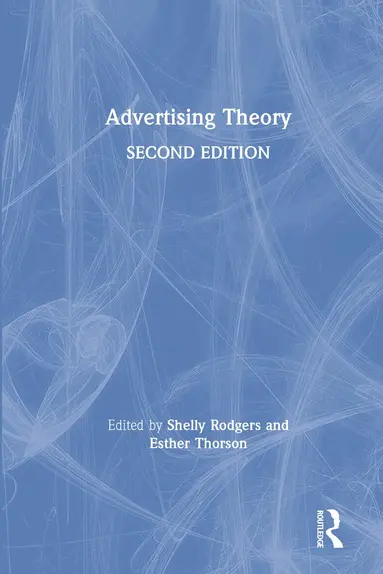
“Theory is what lets you carry a lesson from one campaign to the next, rather than start over each time. Rodgers and Thorson artfully build a text around that premise, and no book has shaped my graduate teaching more: students stop collecting examples and start recognizing mechanisms, whether they're bound for industry or academia. Each edition more than earns its place; this one meets an increasingly digital, data-driven, and AI-enabled world head-on with the rigor the moment requires.”Janelle Applequist, University of South Florida, USA“In a rapidly evolving media landscape, navigating modern advertising could sometimes feel challenging. This 3rd edition of Advertising Theory is the much-awaited guiding light we need, bridging core advertising theories with new digital advancements with much clarity. It also delivers deep insights into advertising-essential topics such as consumer attention, narrative advertising, creativity, and health. It is a must-read for students who want to understand the full spectrum of how advertising works. For instructors, it could serve as the definitive text for advertising theory. And for practitioners, it is a critical strategic tool to understand the deeper mechanisms of consumer behavior.”Hye Jin Yoon, University of Georgia, USA“Advertising Theory, 3rd Edition is a landmark contribution that sets a new benchmark for advertising scholarship. Expertly curated by Shelly Rodgers and Esther Thorson, this edition seamlessly integrates foundational advertising theories with contemporary developments in artificial intelligence, social media, and emerging technologies. Its intellectual rigor, breadth of scholarship, and practical relevance make it an indispensable resource for students, researchers, educators, and practitioners. This exceptional volume will shape advertising theory and scholarship for years to come.”Joe Phua, Southern Methodist University, USA“Advertising Theory, 3rd Edition is thoughtfully updated to reflect the changing advertising landscape, incorporating discussions of artificial intelligence, algorithmic personalization, and new frontiers in social media environments, while preserving the foundational conceptual frameworks that explain how advertising works. This book is invaluable for researchers and instructors teaching advertising theory, particularly those who seek to challenge students to think critically about the processes involved in researching, creating, interpreting, and evaluating advertising messages and their effects.”Juliana Fernandes, University of Florida, USA“Advertising Theory, 3rd Edition offers exceptionally comprehensive coverage of the major advertising theories across contexts. Its distinctiveness lies in how effectively it connects foundational advertising theories with emerging digital, data-driven, and AI-enabled developments, connecting foundational scholarship with contemporary research and advertising practice. This forward-looking volume provides a timely, integrated account of how advertising theory is evolving in response to rapidly changing media environments. Its well-organized structure and range of topics make it a go-to resource for students, researchers, educators, and practitioners seeking to understand, teach, investigate, and apply advertising theory within their respective professional and scholarly contexts.”Sigal Segev, Florida International University, USA"Advertising theory has never been more important. In an era of continuous disruption and AI-driven transformation, it provides the conceptual compass needed to understand, explain, and anticipate how audiences respond to rapidly evolving advertising practices and technologies. Advertising Theory, 3rd Edition, brings together leading international scholars to present the discipline's most influential theories in a comprehensive and exceptionally well-organized volume. Essential reading for anyone seeking a rigorous understanding of advertising theory."Tobias Langner, University of Wuppertal, Germany“Advertising keeps changing faster than our theories, which is why a volume like this is so needed. Rodgers and Thorson pair foundational perspectives with insightful new chapters on AI, personalization, virtual influencers, and transparency, all held together by an integrative framework that actually integrates. Generous in scope and careful in argument, this is a book researchers, students, and advertising practitioners will all be glad to have nearby.”Colin Campbell, University of San Diego, USA and Editor-in-Chief, Journal of Advertising Research