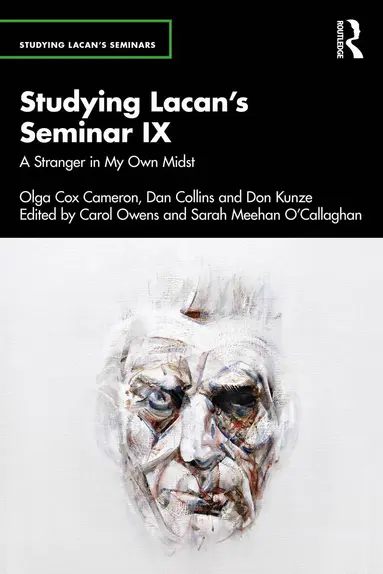
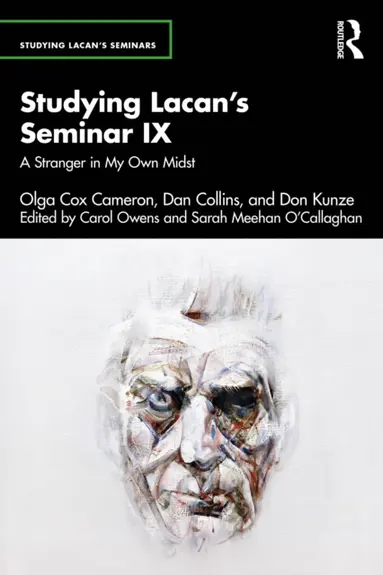
"Two problems invariably confront any attempt to offer extensive commentary on Lacan’s Seminar. There is the staggering range of Lacan’s literary and scholastic references, firstly, and then there is the extended period of time that Lacan allows himself, over each year-long seminar, to lucubrate over a series of topics and questions in his own distinctively elliptical and elusive way. How then to respond to these challenges and offer a novel type of engagement, especially so in reference to a seminar as (relatively) neglected as Seminar IX? Well, by assembling a veritable ‘dream team’ of scholars – Olga Cox Cameron, Dan Collins, and Don Kunze, each of whom have been immersed in the material for decades – one that is able to bypass the standard stereotypical readings of Lacan’s work and isolate the questions and topics that have hitherto been missed or only inadequately appreciated. Working collaboratively, with a multi-disciplinary range exceeding that of any one scholarly expert, the team behind Studying Lacan’s Seminar XI has produced a landmark in Lacanian scholarship; one which matches Lacan’s conceptual brilliance with brilliance and originality all of its own."Derek Hook, Professor of Psychoanalysis, Duquesne University, psychoanalyst"In this extensive volume of commentary, Olga Cox Cameron, Dan Collins, and Don Kunze take us on a romp through one of Lacan’s most unusual seminars – Seminar IX: Identification – highlighting, problematising, and clarifying such arid topics as the unary trait, the topology of Möbius strips, tori, and cross caps, the origin of the psychoanalytic subject, the fundamental fantasy, object a, i(a), and more. They present Lacan’s transitional work here in the context of what came before in his seminars and what was soon to come in his work. The reader should expect to come away enlightened, perplexed, and even … disoriented."Bruce Fink, Lacanian psychoanalyst, author, and translator"This text is an essential reference for anyone seeking to grasp the foundations of Jacques Lacan’s Seminar IX: Identification (1961–1962). Three Lacanian scholars engage with the seminar’s key problems from distinct perspectives, offering an expansive commentary that sheds light on its dense theoretical terrain. Olga Cox Cameron, Dan Collins, and Don Kunze, two psychoanalysts and a geographer, each provide rich and insightful readings of the central concepts concerning identification. What is the origin of the subject and how it emerges? What unifies and anchors the subject? These questions are explored through notions such as the unary trait, signifying repetition, the ego ideal, the phallus, and object a as situated at the core of demand and desire. These themes are developed through the logic Lacan championed – what he called 'elastic and supple' – explored via the extimate space (the topological rendering of the intimate external and the exterior intimate) of the Euler circles, torus, the double torus, and the cross-cap.The difficulty of this seminar – which the commentators work to subdue – lies in its sustained reliance on topological thinking. Topology, after all, is a discipline that thinks the unrepresentable. Every analyst or Lacanian scholar who has engaged with this material has likely asked the question the authors keep returning to: 'Do we really need all this theory?' In response, each commentator articulates, in a singular style, a compelling answer.Olga Cox Cameron’s vivacious, humorous expressions and no-nonsense voice offer a necessary counterpoint to the seminar’s austerity. Her strength lies in situating complex concepts within the broader history of ideas, rendering navigable the transition from the pathos of Seminar VI (Desire and Its Interpretation) to the formal logic of Identification, and onward to the developments of Seminar X (Anxiety). Olga brings a critical edge to Lacanian thought by questioning the phallocentric dimension of analytic theory – not by rehearsing commonplace feminist critiques, but with an eye to their clinical and theoretical stakes.Dan Collins brings precision to the project. His clarity is enthusiastically received, as he nuances the topological discussions with the expertise of both a clinician and a literary critic. His ability to distill Lacan’s often-dense arguments into short, accessible insights cuts through the text’s inherent difficulty with remarkable lucidity.Don Kunze, in turn, contributes a distinctive geographical and abstract spatial reflection on extimacy, drawing on cultural examples to ground his analysis. He approaches Lacan’s topological references systematically, and in doing so, 'fractalizes' Lacan’s arguments – highlighting structural mechanisms revealed through inversions and inductions.Together, this triad of commentators – Olga’s vibrant contextualization, Dan’s clarifying precision, and Don’s challenging structural visualizations – performs the very 'arduous thinking' Lacan demands. Each offers a distinct key to unlock the seminar’s formal investigation into the subject’s origin in the signifier.By curating this remarkable set of contributors, editors Carol Owens and Sarah Meehan O’Callaghan have assembled a tour de force that is sure to leave a significant mark on the psychoanalytic understanding of identification." Hilda Fernandez-Alvarez, President: Corpo freudiano Vancouver Lacanian School of Psychoanalysis