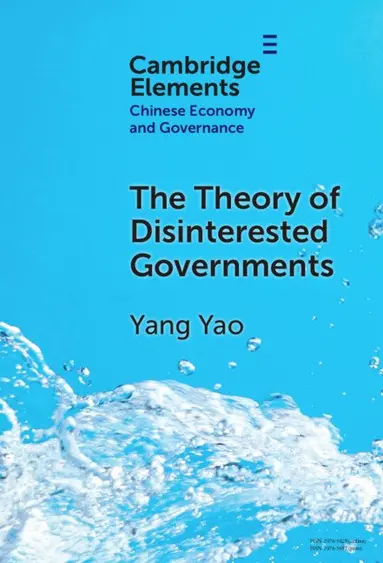
The Theory of Disinterested Governments
A Political Economy Explanation for China's Economic Ascent
280 kr
Kommande. Bevaka för att få ett mejl när produkten kan beställas.
Fler format och utgåvor
Beskrivning
This element proposes the theory of disinterested governments to explain China's economic ascent. A disinterested government is a government that neither represents, nor is captured by the interests of any social groups. It is more likely than a biased government to avoid allocative inefficiency and increase output. A theoretical model of coalition formation finds that a more politically equal society is more likely to produce a disinterested government. Empirical evidence shows that the Chinese government has behaved in a disinterested fashion in the reform era. Social equality established by a series of social transformations has been identified as the cause for Chinese government's acting in a disinterested fashion in the reform era. Cross-country case studies and regression analysis have established a chain of causality running from political equality to the inclusive (disinterested) state, and then to faster economic growth. This title is also available as Open Access on Cambridge Core.
Produktinformation
Utforska kategorier
Innehållsförteckning
Hoppa över listan
Mer från samma serie
Elite Conflicts and the Path to Economic Decentralization
Dong Zhang, Mingxing Liu, Victor Shih
Häftad, 2025
308 kr
Elite Conflicts and the Path to Economic Decentralization
Dong Zhang, Mingxing Liu, Victor Shih
Inbunden, 2025
911 kr