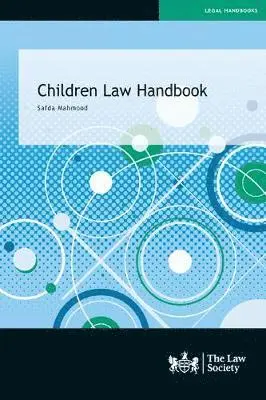
Child Care and Protection: Law and Practice
723 kr
Skickas . Fri frakt över 249 kr.
Beskrivning
Produktinformation
- Utgivningsdatum:2024-09-20
- Mått:138 x 216 x 23 mm
- Vikt:406 g
- Format:Häftad
- Språk:Engelska
- Antal sidor:320
- Upplaga:7
- Förlag:Wildy, Simmonds and Hill Publishing
- ISBN:9780854903061
Utforska kategorier
Mer om författaren
Safda has practised as a solicitor in both the private and the public sector. He is a solicitor, manager, and team leader in Advocacy with Coventry City Council, Legal Services Department. Safda runs training courses across England and Wales to members of the legal profession, and other professionals. Julie recently retired as a senior lecturer in law at Cardiff University School. She has written widely on children’s rights; adoption; and open justice. She has practice experience as a former solicitor and with Cafcass
Recensioner i media
'All practitioners have to do is read it, apply it, and reap the benefits. I recommend this book to other practitioners.'From review of new edition by Dominik Morton, St John’s Chamber in Pink Tape'an excellent introduction to a complex area of law.'From review of previous edition in Law Society Gazette
Innehållsförteckning
- PrefaceAcknowledgementsList of AbbreviationsList of Figures and Tables1 Glossary and Legislative Framework1.1 Glossary of basic definitions1.2 Orders available under the Children Act 19891.3 Introduction to the Children Act 19891.4 Changes to the Children Act 1989 introduced with the Family Court in 20142 Principles Underlying the Children Act 19892.1 Paramountcy of the welfare of the child2.1.1 Welfare checklist2.2 Delay is deemed prejudicial to child’s interests (the impact of the Public Law Outline)2.3 No order unless necessary in the interests of the child3 Parental Responsibility3.1 Definition, powers and duties of parental responsibility3.1.1 Duration3.1.2 Parental responsibility and medical consent3.1.3 What if there is no one with parental responsibility?3.2 Legal position of child’s birth mother3.3 Legal position of child’s father3.3.1 Married fathers and those who are civil partners3.3.2 Unmarried fathers3.4 Acquisition and loss of parental responsibility by child’s birth father3.4.1 Parental responsibility order3.4.2 Parental responsibility agreement with the mother3.4.3 Joint registration of the birth by father and mother3.4.4 Child arrangements order, specifying living with, and parental responsibility3.5 Acquisition of parental responsibility by others3.5.1 Relatives3.5.2 Step-parents3.5.3 Non-relatives3.5.4 Guardianship3.5.5 Special guardianship order3.5.6 Parental responsibility, surrogacy and the Human Fertilisation and Embryology Act 20083.5.7 Parental orders under section 54 of the Human Fertilisation and Embryology Act 20083.6 Public funding in children cases3.6.1 Public funding changes4 Every Child Matters: Child Protection Procedures in Health and Social Work4.1 Safeguarding partners, child safeguarding practice reviews, child practice reviews and child death review partners4.1.1 Safeguarding partners and child safeguarding practice reviews4.1.2 Child death review partners4.1.3 Child practice reviews4.2 Hierarchy within social services departments4.3 Referral procedures and preliminary investigations4.3.1 Involving the child4.3.2 Involving families and information sharing4.4 Child protection conferences4.4.1 Purpose4.4.2 Who should be invited to a child protection conference?4.4.3 Documents4.4.4 Decisions to be made and actions to be taken4.4.5 Categories of abuse4.4.6 Criteria for discontinuance of the child protection plan4.5 Assessment of risk4.6 Child protection plan4.7 Child and Family Court Advisory Support Service4.8 Local authority duty to promote welfare of children in its area4.8.1 Duty to investigate potential or actual harm to child4.8.2 Local authority duty to children in need4.8.3 Services for children and their families4.8.4 Duty to children aged under 54.8.5 Compliance with court order to investigate child’s circumstances, section 37 of the Children Act 19894.8.6 Looked after children: responsibility of the local authority5 Emergency Protection Orders5.1 Effects of order5.2 Duration5.3 Grounds for application5.4 Practice and procedure5.4.1 Application5.4.2 Respondents5.4.3 Applications made without notice (previously referred to as ex parte applications)5.4.4 Notice5.4.5 Service5.4.6 Attendance5.5 Contact, accommodation and the rights of the child5.5.1 Contact5.5.2 Accommodation5.5.3 Rights of the child5.6 Variation and discharge5.7 Exclusion requirement under emergency protection order5.7.1 Two notes of caution5.8 How do ‘without notice’ orders and Article 6 of the ECHR fit together?5.9 Emergency applications and newborn children5.9.1 Out of hours emergency protection order applications6 Child Assessment Orders6.1 Effects of order6.2 Grounds for application6.3 Practice and procedure6.3.1 Application6.3.2 Venue6.3.3 Respondents6.3.4 Notice6.3.5 Service6.3.6 Generally6.3.7 Discharge of order6.4 Contact, accommodation and the rights of the child6.4.1 Contact6.4.2 Accommodation6.4.3 Rights of the child6.5 Appeals, variation and discharge7 Care and Supervision Proceedings7.1 Care order – definitions7.2 Grounds for application for a care or supervision order7.3 Significant harm7.3.1 Standard of proof7.3.2 Linking harm or likelihood of harm to the facts and test for separation7.4 Practice and procedure7.4.1 Applicants and public funding7.4.2 Venue7.4.3 Form7.4.4 Respondents7.4.5 Notice and court actions on issue7.4.6 Service7.4.7 Attendance7.5 Interim orders7.6 Effects of care order7.6.1 Duration7.6.2 Parental responsibility and care plans7.6.3 Proportionality, kinship care and local authority accommodation of the child7.6.4 Planning transition to adulthood7.6.5 Contact with a child in care7.6.6 Rights of the child in care proceedings and under a care order7.6.7 Rights of parents of a child in care7.7 Public Law Outline – principles, ‘fact-finding hearings’, issues resolution, interim and final hearings7.7.1 Main principles of the Public Law Outline (Practice Direction 12A)7.7.2 Various parts of Practice Direction 12A7.7.3 Fact-finding hearings/split hearings7.7.4 Practice Direction 12A checklists7.8 Assessments and care planning7.9 Effects of supervision order7.9.1 Interim orders7.9.2 Duration of care and supervision7.9.3 Directions in supervision orders7.9.4 Enforcement7.9.5 Designated local authority7.10 Removal of child from care7.11 Variation, discharge and appeals7.11.1 Variation and discharge7.11.2 Appeals7.12 Effects of the Human Rights Act 1998 on care and supervision proceedings8 Secure Accommodation and Deprivation of Liberty Orders8.1 Restricting liberty with a secure accommodation order8.1.1 Safeguards8.1.2 Criminal cases (secure orders)8.1.3 Use of secure accommodation in civil cases8.2 How long can a child be kept in secure accommodation?8.2.1 Where no court order made8.2.2 Secure order (child on remand in a criminal case)8.2.3 Civil cases and children not on criminal remand – secure accommodation orders8.2.4 Adjournments8.3 Grounds for application8.3.1 Children detained in criminal cases8.3.2 Children in civil cases8.3.3 Deprivation of liberty and secure accommodation8.3.4 Welfare of the child and secure accommodation8.4 Practice and procedure8.4.1 Application8.4.2 Forms8.4.3 Venue8.4.4 Respondents8.4.5 Notice8.4.6 Service8.5 Role of the children’s guardian8.6 Contact8.7 Rights of the child8.7.1 Reviews8.7.2 Attendance at court8.7.3 Public funding8.7.4 Right to legal advice8.7.5 Age of child8.8 Appeals and the Human Rights Act 19988.9 Deprivation of liberty orders8.9.1 What constitutes a deprivation of liberty?8.9.2 Applications for a deprivation of liberty order and the National DoL List8.9.3 Use of the inherent jurisdiction and position surrounding the child’s consent8.9.4 Court of Protection and deprivation of liberty applications8.9.5 Shortage of placements and ongoing difficulties8.9.6 Deprivation of liberty orders and enforceability in Scotland8.9.7 Unregistered placements and supported placements9 Education Supervision Orders9.1 Effects of an education supervision order9.2 Duration9.3 Grounds for application9.4 Practice and procedure9.4.1 Application9.4.2 Venue9.4.3 Notice9.4.4 Respondents9.4.5 Service9.5 Rights of the child9.6 Variation, discharge and appeals9.6.1 Appeals10 Police Powers under the Children Act 198910.1 Police powers and responsibilities10.2 Contact with child11 Instructions and Case Preparation in Family Proceedings11.1 Action plan on receipt of instructions from an adult or local authority11.2 Interviewing clients11.2.1 Checklist for information from parents11.2.2 Checklist for Public Law Outline requirements on information from local authorities and social workers11.2.3 Checklist for basic initial information from medical witnesses11.2.4 Working with parents with a learning disability and participation directions11.3 Preparation of the case11.4 Burden of proof and standard of proof in child law cases11.5 Special evidence rules in child law cases11.5.1 Character11.5.2 Best evidence and hearsay11.5.3 Opinion11.5.4 Statements made by children’s guardians11.5.5 No professional privilege for medical or psychiatric reports11.5.6 Case management hearings – ordering the evidence11.6 Court procedure at the hearing11.6.1 Notes of evidence11.6.2 Order of evidence11.6.3 Extent of evidence11.6.4 Case management hearing/issues resolution hearing: key checklist matters for advocate to consider11.7 Courtroom skills11.7.1 Court manners11.8 Transparency11.8.1 Media attendance and reporting hearings11.8.2 Objections to attendance12 Children’s Rights12.1 To accept or refuse medical treatment12.1.1 Children aged over 16 (but under 18)12.1.2 Children aged under 1612.1.3 Children who lack capacity to make a decision12.1.4 Where no available person has parental responsibility12.2 To accept or refuse medical or psychiatric assessment12.2.1 Circumstances in which the court may direct medical or psychiatric examination or assessment which the child has a right to refuse12.3 To make his or her own application to the court12.4 To request confidentiality and, in the event of disagreement with the children’s guardian, to instruct a solicitor separately12.5 Rights of a child in care12.6 UN Convention on the Rights of the Child13 Other Orders available to the Court in Family Proceedings13.1 Orders in family proceedings13.2 Section 8 orders13.2.1 Leave to apply13.2.2 Considerations on application for leave13.2.3 Duration13.2.4 When the court may not make an order under section 8 of the Children Act 198913.2.5 Welfare reports in applications under section 8 of the Children Act 198913.3 Contact (spending time with, or otherwise having contact with)13.3.1 Contact disputes13.3.2 Activity orders13.4 Prohibited steps13.5 Residence (living with)13.5.1 Residence and parental responsibility13.6 Specific issue13.7 Supplementary provisions13.8 Practice and procedure in applications under section 8 of the Children Act 198913.8.1 Mediation Information and Assessment Meetings and non-court dispute resolution13.8.2 Applications13.8.3 Venue13.8.4 Notice of application for orders under section 8 of the Children Act 198913.8.5 Respondents13.8.6 Service13.8.7 Applications made without notice (formerly known as ex parte procedures)13.8.8 Withdrawal, variation, discharge and appeals13.9 Family assistance order14 Commencement and Transfer of Proceedings14.1 General rules14.2 Applicants and allocation of family case14.2.1 Proceedings which must be commenced in the Family Division of the High Court14.2.2 Proceedings which must be commenced in the Family Court14.3 Transfers14.4 Urgent applications15 Working with Children15.1 Appointment and role of the children’s guardian15.1.1 Official Solicitor15.1.2 Public funding, access to information and disclosure15.1.3 Specified proceedings15.2 Conflict between children’s guardian and child15.2.1 Confidentiality15.3 Should I see my child client?15.3.1 Meeting a child client15.3.2 Decisions concerning a child’s competence15.4 Taking instructions and communicating with children15.4.1 Guidelines on effective meetings and communication with children15.5 Child development15.6 Understanding your child client – race, religion, culture and ethnicity15.7 After the case is over15.8 Judges seeing children in children law proceedings16 Assessment of Children in Need and Care Planning16.1 Developments and materials16.1.2 Resources for professionals16.2 Assessment Framework16.3 Care planning16.4 Adoption issues16.4.1 Legislation and other materials16.4.2 Independent Review Mechanism16.4.3 Publications17 Appeals and Enforcement17.1 Appeals and judicial review17.1.1 Appeal process and when permission is required17.1.2 Time limits for notice and procedure17.1.3 If permission is refused17.1.4 When will permission be granted?17.1.5 Judge sitting in Family Court appeals17.1.6 Lay justices/magistrates appeals17.1.7 Circuit judge or recorder appeals17.1.8 Judge of High Court Judge level appeals17.2 Complaints procedures17.3 Enforcement18 Expert Evidence18.1 What is an expert witness?18.2 Choosing and instructing expert witnesses18.2.1 Funding issues and prior authority from the Legal Aid Agency to instruct expert witnesses18.3 Expert witness evidence18.3.1 Expert instruction checklist18.4 Expert evidence in court18.5 Finding the right expert18.5.1 Registers and directories18.5.2 Online resources19 Improving Law, Skills and Practice19.1 Professional and interdisciplinary associations19.2 The Law Society’s Children Law Accreditation19.3 Sources of useful information and contacts for children and families, and those who work with them
Du kanske också är intresserad av
- -15% på allt
Transparency in the Family Courts: Publicity and Privacy in Practice
Julie Doughty, Lucy Reed KC, Paul Magrath
1 291 kr
Transparency in the Family Courts: Publicity and Privacy in Practice
Julie Doughty, Lucy Reed KC, Paul Magrath
1 291 kr
Transparency in the Family Courts: Publicity and Privacy in Practice
Julie Doughty, Lucy Reed KC, Paul Magrath
Häftad, 2024
1 362 kr
- -52%
Pixi adventskalender 2025 : Med böcker av Maria Trolle, Maria Nilsson Thore, Johan Anderblad, Filippa Widlund, Mårten Melin Elsa Beskow, Lotta Olsson mfl
Flera Författare
Häftad, 2025
129 kr269 kr
- -15% på allt
Berätta inte för någon : min uppväxt i Jehovas vittnen
Ida Halonen Bomban, Leone Milton
Inbunden, 2026
259 kr
- -48%
Pixi adventskalender – Mattias Andersson
Bonnier Carlsen
Häftad, 2024
129 kr249 kr