
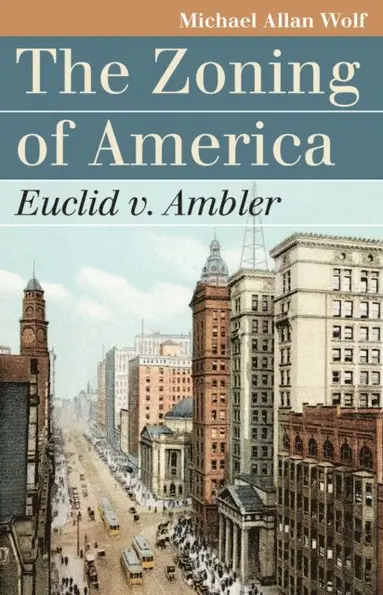
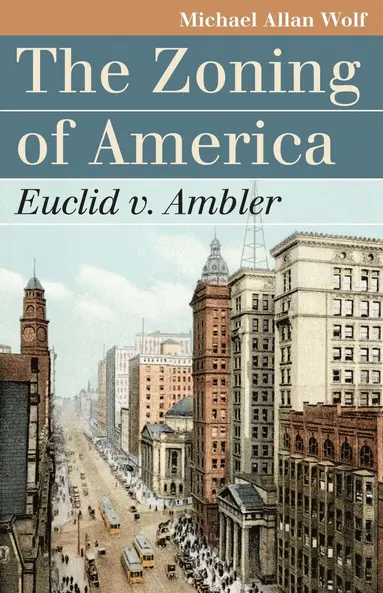
The Zoning of America
Euclid V. Ambler
285 kr
Kommande. Bevaka för att få ett mejl när produkten kan beställas.
Fler format och utgåvor
Beskrivning
A timely new edition of the definitive book on Euclid v. Ambler, the landmark Supreme Court case—in recognition of its 100th anniversary.When the Cleveland suburb of Euclid first zoned its land in 1922, the Ambler Realty Company found itself with a sizable tract, most of which it could no longer sell or develop for industrial use—and sued. The dispute became the seminal zoning case in U.S. Supreme Court history, pitting the authority of local government against private property rights and forcing the justices to confront a consequential question: Could a municipality restrict how owners used their land in the name of the public good?Michael Allan Wolf’s authoritative study reconstructs the legal battle that culminated in the Supreme Court’s landmark 1926 Euclid v. Ambler decision. He reveals how Justice George Sutherland broke with the Court’s conservative bloc to uphold zoning and support an urban reform movement seeking to separate residential neighborhoods from rapidly expanding commercial, industrial, and multifamily land uses. The decision helped spur the nationwide proliferation of zoning ordinances and dramatically expanded the power of local governments to shape development. There is also a personal side to this tale, which pitted a zealous local practitioner, James Metzenbaum, against a Progressive legend, former Secretary of War Newton D. Baker.A century later, Euclid v. Ambler remains at the center of some of America’s most urgent social, economic, and political debates. Zoning has provided communities with powerful tools to guide growth and protect neighborhoods, but it has also contributed to suburban sprawl, constrained the supply of affordable housing, and enabled patterns of economic and racial exclusion.For this updated second edition, Wolf adds a new chapter examining Euclid v. Ambler’s increasingly contested legacy amid debates over housing affordability, climate change, residential segregation, and government regulation. He explores challenges to single-family zoning from the left alongside growing skepticism of Euclid v. Ambler’s regulatory framework among legal conservatives and members of the Roberts Court. As Wolf shows, the current Supreme Court, in its effort to increase the power of the courts over local and state lawmakers, has mischaracterized the facts and holding of Euclid v. Ambler.Wolf’s compelling account makes clear that Euclid v. Ambler fundamentally altered how we think about the urban landscape, reshaped the organization of American cities and suburbs, and cast a long shadow over subsequent cases. A century later, the decision continues to reverberate even as traditional, “Euclidean” zoning’s future is increasingly uncertain. Whether Euclid v. Ambler survives or fails, this centennial edition remains the definitive account of how one Supreme Court decision changed America, and why its legacy matters more than ever.
Produktinformation
Utforska kategorier
Mer om författaren


Hoppa över listan







Du kanske också är intresserad av
- -15% på allt
- Signerad!
- -15% på allt
Del 4
- -15% på allt
- -52%
Pixi adventskalender 2025 : Med böcker av Maria Trolle, Maria Nilsson Thore, Johan Anderblad, Filippa Widlund, Mårten Melin Elsa Beskow, Lotta Olsson mfl
Flera Författare
Häftad, 2025
129 kr269 kr
- -48%
- -48%