- -15% på allt
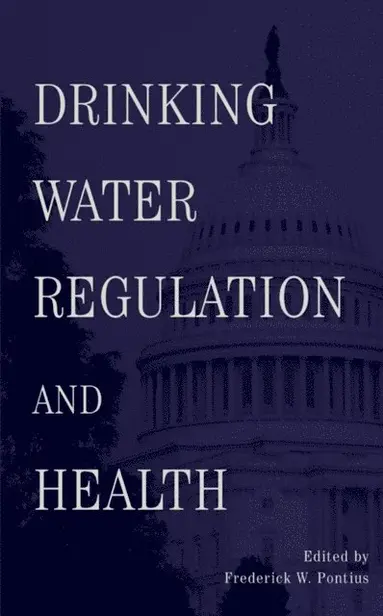
Drinking Water Regulation and Health
2 239 kr
Beställningsvara. Skickas inom 11-20 vardagar. Fri frakt över 249 kr.
Fler format och utgåvor
Beskrivning
Produktinformation
- Utgivningsdatum:2003-06-05
- Mått:163 x 242 x 53 mm
- Vikt:1 592 g
- Format:Inbunden
- Språk:Engelska
- Antal sidor:1 072
- Förlag:John Wiley & Sons Inc
- ISBN:9780471415541
Utforska kategorier
Mer om författaren
FREDERICK W. PONTIUS is the President of Pontius Water Consultants, Inc., and provides drinking waterrelated professional engineering services to water utilities, consultants, industry, businesses, and regulatory agencies. He has over twenty years of experience in public water supply, has authored the Safe Drinking Water Act Advisor treatise on drinking water rules, and is a frequent speaker on drinking water regulation, compliance, and health.
Recensioner i media
“...a 'one-stop shopping' compendium of information...another valuable addition to the environmental professional's library of critical references.” (Environmental Practice, March 2005) "This book is a must-read for water utilities, consultants, and regulators…it not only explains the regulations and the regulatory process, but also provides essential information on water treatment, water protection, public health, and future issues." (Journal of Environmental Quality, May-June 2004)
Innehållsförteckning
- Preface xixAcknowledgments xxiContributors xxiiiAcronyms xxviiPART I THE SAFE DRINKING WATER ACT AND PUBLIC HEALTH 11 Drinking Water and Public Health Protection 3 Daniel A. Okun1.1 Introduction, 31.2 Water Supply for the City of Rome, 41.3 The Middle Ages and the Industrial Revolution, 51.4 The Great Sanitary Awakening, 61.5 The Emergence of Water as a Public Health Issue, 91.6 The Beginning of Water Treatment, 111.7 The Chemical Revolution, 131.8 The Introduction of Regulations, 141.9 Prelude to the 1974 Safe Drinking Water Act, 171.10 Drinking Water in Developing Countries, 191.11 The Future of Public Water Supply, 212 Improving Waterborne Disease Surveillance 25 Floyd J. Frost, Rebecca L. Calderon and Gunther F. Craun2.1 Introduction, 252.2 Background, 262.3 Limitations of the Current Disease Surveillance Systems, 282.4 Early Detection of Outbreaks, 312.5 Endemic Disease, 322.6 Applicability of Outbreak Investigations, 342.7 Monitoring Infection Versus Disease, 362.8 Improving Disease Surveillance, 383 Waterborne Outbreaks in the United States, 1971–2000 45 Gunther F. Craun, Rebecca L. Calderon, and Michael F. Craun3.1 Introduction, 453.2 Waterborne Disease Outbreak Surveillance System, 463.3 Waterborne Outbreak Statistics, 483.4 Causes of Outbreaks in Drinking Water Systems, 553.5 Outbreaks Associated with Recreational Waters, 613.6 Outbreak Trends, 654 History of the Safe Drinking Water Act (SDWA) 71Frederick W. Pontius4.1 Introduction, 714.2 Early Development of Drinking Water Standards, 724.3 The Safe Drinking Water Act of 1974, 734.4 1986 SDWA Amendments, 794.5 1988 Lead Contamination Control Act, 804.6 1996 SDWA Amendments, 814.7 Public Health Security and Bioterrorism Preparedness and Response Act, 914.8 Future Outlook, 955 SDWA: Looking to the Future 105 Diane VanDe Hei and Thomas Schaeffer5.1 Introduction, 1055.2 U.S. Governmental Structure, 1055.3 How Laws Are Made, 1075.4 Forces Shaping the SDWA and Amendments, 1115.5 Future Amendments to the SDWA, 1215.6 Outlook for Major Change, 0127PART II REGULATION DEVELOPMENT 1316 Toxicological Basis for Drinking Water Risk Assessment 133 Joyce Morrissey Donohue and Jennifer Orme-Zavaleta6.1 Introduction, 1336.2 Toxicological Evaluation of Drinking Water Contaminants, 1336.3 Use of Toxicity Information in Risk Assessment, 1376.4 Health Advisories, 1436.5 Future Outlook, 1457 Epidemiologic Concepts for Interpreting Findings in Studies of Drinking Water Exposures 147 Gunther F. Craun, Rebecca L. Calderon and Floyd J. Frost7.1 Introduction, 1477.2 What Is Epidemiology?, 1497.3 Historical Origins, 1497.4 Disease Models, 1507.5 Basic Measures of Disease Frequency, 1527.6 Types of Epidemiologic Studies, 1567.7 Examples: Experimental, Cohort, and Case–Control Studies, 1707.8 Future Trends in Epidemiology and Drinking Water, 1788 Application of Risk Assessments in Crafting Drinking Water Regulations 183 Bruce A. Macler8.1 Introduction, 1838.2 Risk Assessment Approaches for Drinking Water Regulations, 1848.3 Risk Mandates from the Safe Drinking Water Act, 1888.4 Developing MCLs and Treatment Techniques, 1898.5 Future Outlook, 1959 ‘‘Sound’’ Science and Drinking Water Regulation 197 Frederick W. Pontius9.1 Introduction, 1979.2 Elements of ‘‘Sound’’ Science, 1989.3 Peer Involvement, 2069.4 Scientific Disagreement, 2099.5 ‘‘Junk’’ Science, 2109.6 Causation and Causal Inference, 2119.7 Science and SDWA Regulations, 2149.8 Science and the Courts, 2159.9 Future Developments and Trends, 22110 Benefit–Cost Analysis and Drinking Water Regulation 225 Robert S. Raucher10.1 Introduction, 22510.2 Benefit–Cost Analysis (BCA) Under the SDWA, 22610.3 Historical Application of BCA, 22710.4 USEPA Policies and Practices, 22810.5 Comparing Benefits to Costs, 22910.6 Measures of Risk Reduction Benefits, 23310.7 Benefits Transfer to Drinking Water, 238 and Income Growth, 24110.8 Uncertainty and Variability, 24210.9 Precautionary Assumptions versus Central Tendencies, 24410.10 Omitted or Unquantified Benefits and Costs, 24610.11 Uncertain Costs, 24710.12 Future Outlook, 24711 Public Involvement in Regulation Development 251 Frederick W. Pontius11.1 Introduction, 25111.2 Who is the Public?, 25111.3 Objectives Determine Involvement Level, 25211.4 Involvement during the Rulemaking Process, 25311.5 Federal Agency Advisory Committees, 26111.6 Regulatory Negotiation, 26611.7 Judicial Review, 26811.8 USEPA’s Public Involvement Policy, 26911.9 The Future of Public Participation, 271PART III CONTAMINANT REGULATION AND TREATMENT 27512 Control of Drinking Water Pathogens and Disinfection Byproducts 277 Stig E. Regli, Paul S. Berger and Thomas R. Grubbs12.1 Introduction, 27712.2 Control of Waterborne Pathogens Before the 1970s, 27712.3 Control of Waterborne Pathogens and DBPs in the 1970s, 28012.4 Control of Waterborne Pathogens and DBPs in the 1980s, 28412.5 Control of Waterborne Pathogens and DBPs in the 1990s and Beyond, 28912.6 A View Toward the Future, 30113 Regulating Radionuclides in Drinking Water 307 David R. Huber13.1 Introduction, 30713.2 Radiation Basics, 31013.3 SDWA Requirements for Radionuclide Standards, 31213.4 1976 Radionuclide Regulations, 31413.5 1991 Proposed Radionuclides Rule, 31713.6 1996 SDWA Amendments and Rule Revisions, 31813.7 2000 Final Radionuclides Rule, 32213.8 Future Outlook, 33614 Risk-Based Framework for Future Regulatory Decision-Making 339 Mark Gibson and Mike Osinsiki14.1 Introduction, 33914.2 SDWA Amendments of 1996, 34014.3 Role of Third-Party Consultations in Regulatory Development, 34214.4 Role of USEPA Programs, 34414.5 Development of the First CCL, 34714.6 Public Health Decisions from the 1998 CCL, 34914.7 Development of Future CCLs, 35614.8 Illustration of a Prototype Classification Scheme, 36814.9 Virulence Factor–Activity Relationships (VFARs), 37514.10 NRC Recommendations and Future Directions, 37615 Selection of Treatment Technology for SDWA Compliance 381 Frederick W. Pontius15.1 Introduction, 38115.2 SDWA Requirements Affecting Technology Selection, 38115.3 Acceptance of New Technology, 38515.4 Advanced Treatment Technology Overview, 38615.5 Simultaneous Compliance, 39515.6 Process Optimization, 39615.7 Technology Selection, 39616 SDWA Compliance Using Point-of-Use (POU) and Point-of-Entry (POE) Treatment 403 Frederick W. Pontius, Regu P. Regunathan and Joseph F. Harrison16.1 Introduction, 40316.2 POU and POE Technology Benefits, 40416.3 POU and POE Technology Limitations, 40516.4 SDWA Requirements for POU and POE Technology, 40716.5 Certification Programs, 40816.6 POU and POE Technology Overview, 41116.7 Selecting POU and POE Technologies, 41716.8 Installation and Maintenance, 42016.9 Monitoring, 42216.10 Implementation Issues and Strategies, 42216.11 Future Outlook and Trends, 427PART IV COMPLIANCE CHALLENGES 43117 Death of the Silent Service: Meeting Consumer Expectations 433 Elisa M. Speranza17.1 Introduction, 43317.2 Who Are Water Utility Customers?, 43317.3 Public Water Suppliers as a Monopoly, 43617.4 Where Customers Obtain Information, 43617.5 What Customers Think and Want, 43717.6 Gaining Customer Support, 44117.7 Communicating with Customers, 44117.8 Benefits of Customer Communication, 44618 Achieving the Capacity to Comply 449 Peter E. Shanaghan and Jennifer Bielanski18.1 Introduction, 44918.2 Water System Capacity, 45018.3 Assessing Water System Capacity, 45218.4 Enhancing System Capacity, 45518.5 Future Outlook, 46119 Achieving Sustainable Water Systems 463 Janice A. Beecher19.1 Introduction, 46319.2 Sustainable Systems, 46419.3 Sustainability and the SDWA, 46819.4 Affordability and Sustainability, 47319.5 Pricing Theory, 47719.6 Rate Design, 48119.7 Future Trends in Achieving Sustainability, 48720 Protecting Sensitive Subpopulations 491 Jeffrey K. Griffiths20.1 Introduction, 49120.2 Defining Sensitive Subpopulations, 49120.3 Sensitive Subpopulations and the SDWA, 49220.4 Identifying Sensitive Subpopulations, 49320.5 What Makes a Person or Population Sensitive?, 49520.6 Which Sensitive Subpopulations Are of Concern to Water Providers?, 50520.7 Can or Should a Water Supplier Identify Who Belongs to a Sensitive Subpopulation?, 50620.8 Nontransient and Transient Noncommunity Systems, 50620.9 Public Health Concepts Relevant to Sensitive Subpopulations, 50720.10 Future Outlook, 50921 Environmental Justice and Drinking Water Regulation 513 Frederick W. Pontius21.1 Introduction, 51321.2 Environmental Justice as a Movement, 51321.3 Identifying Environmental Justice Situations, 51721.4 Environmental Justice and Contaminant Regulation, 52621.5 Implications for Water Utilities, 52821.6 Future Outlook, 52922 What Water Suppliers Need to Know about Toxic Tort Litigation 533 Kenneth A. Rubin22.1 Introduction, 53322.2 Basics of Toxic Torts, 53422.3 What Plaintiffs Must Prove, 53822.4 Key Steps in Litigation, 54322.5 Case Histories Involving Water Suppliers, 54922.6 Future Outlook for Tort Litigation, 55223 Intellectual Property Laws and Water Technology 555 Linda E. B. Hansen23.1 Introduction, 55523.2 Property, Copyrights, Trademarks, and Patents, 55523.3 Patent Laws, 55623.4 Obtaining a Patent, 56323.5 Patent Infringement, 56423.6 Future Outlook in Intellectual Property Law, 56624 Water System Security 567 Frederick W. Pontius24.1 Introduction, 56724.2 Threats to Public Water Systems, 56824.3 SDWA Security Provisions, 57024.4 Department of Homeland Security, 57624.5 Future Outlook, 580AppendixesA Summary Tables of Drinking Water Standards and Health Advisories 583USEPA Office of Ground Water and Drinking Water andUSEPA Office of Science and TechnologyB 1962 U.S. Public Health Service Standards 621C Section-by-Section Summary of the SDWA 635 Frederick W. PontiusD Text of the SDWA as Amended and Related Statutes 721 Compiled by Frederick W. PontiusE How Our Laws are Made 871 Charles W. JohnsonF Enactment of a Law 923 Robert B. DoveG Listing of Drinking Water Federal Register Notices 953 Compiled by Frederick W. Pontius, P.E.H Outline of 40 CFR 141, 142, and 143 971 Compiled by Frederick W. PontiusI Example Capacity Development Tool 979 South Dakota Department of Environment and Natural ResourcesJ U.S. Water Industry Statistics 995 USEPA Office of Ground Water and Drinking WaterIndex 1009
Du kanske också är intresserad av
- -15% på allt
Systrarna på Sophiahemmet
Ruth Kvarnström-Jones
Inbunden, 2026
239 kr
- -15% på allt
- -15%
- -15% på allt
Linnea & Viola: vår värld bakom kameran
Linnea Falk, Viola Falk, Ann-Beath Dahlberg Frisk
Inbunden, 2026
159 kr
- -15% på allt
Välkommen till Känslornas Hotell
Lidia Brankovic
Inbunden, 2026
159 kr
- -23%
Hur låter bokstaven?
Susanna Cabander
Inbunden, 2019
269 kr349 kr
- -48%
Pixi adventskalender - Filippa Widlund
Bonnier Carlsen
Häftad, 2023
129 kr249 kr
- -19%