
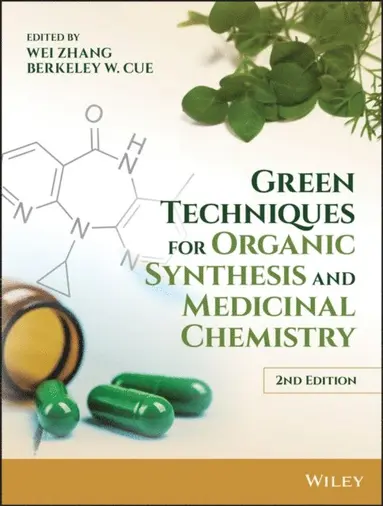
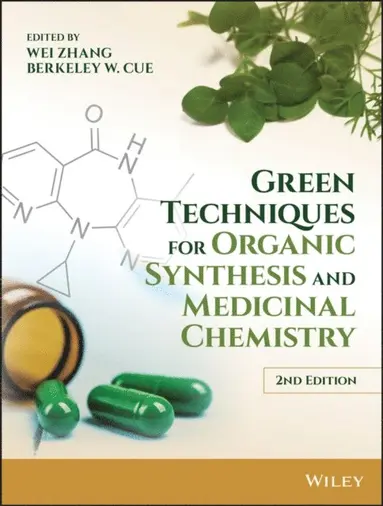
Green Techniques for Organic Synthesis and Medicinal Chemistry
1 979 kr
Tillfälligt slut. Bevaka för att få ett mejl när produkten kan beställas.
Fler format och utgåvor
Beskrivning
Boasting both environmental and economic benefits, green chemistry is becoming a high priority in modern organic synthesis and pharmaceutical R & D. This book fills a gap in the field, offering the only comprehensive treatment focused on green chemistry applications in organic synthesis, medicinal chemistry, and drug discovery. It covers many innovative and new techniques, along with an assessment of the green chemistry aspects and limiting factors for each technique. Coverage also includes green concepts and catalysis, as well as case studies illustrating practical applications in the pharmaceutical industry.
Produktinformation
- Utgivningsdatum:2012-05-29
- Språk:Engelska
- ISBN:9780470711828
- Förlag:John Wiley & Sons Inc
- Dimensioner:189 x 246 x 15 mm
Utforska kategorier
Mer om författaren
Wei Zhang, PhD, is Professor of Chemistry and Director of the Center for Green Chemistry at the University of Massachusetts Boston. He is known for research work in organic synthesis, medicinal chemistry, and green chemistry. He received the 2015 International Fluorous Technology Award and is one of the top three most published authors in fluorous chemistry.Berkeley W. Cue, PhD, is President and Founder of BWC Pharma Consulting LLC, a consultancy specializing in pharmaceutical sciences and green chemistry, and Adjunct Professor of Chemistry at the University of Massachusetts Boston.
Recensioner i media
“In summary, the book covers new advances in green chemistry, which are applied in the pharmaceutical industry. It also shows ways of introducing innovation in a more holistic manner, through the development of smart equipment, techniques, or innovative chemicals.” (Green Processing and Synthesis, 1 August 2012)
Innehållsförteckning
- List of Contributors xix I INTRODUCTION 11 Green Toxicology 3Nicholas D. Anastas1.1 Introduction 31.2 History and Scope of Toxicology 41.2.1 The need for green toxicology 51.3 Principles of Toxicology 51.3.1 Characteristics of exposure 61.3.2 Spectrum of toxic effects 61.3.3 The dose–response relationship 71.4 Disposition of Toxicants in Organisms 81.4.1 Absorption 91.4.2 Distribution 111.4.3 Metabolism 111.4.4 Excretion 121.5 Nonorgan System Toxicity 121.5.1 Carcinogenesis 131.5.2 Reproductive and developmental toxicity 131.5.3 Immunotoxicology 141.6 Mechanistic Toxicology 151.7 Quantitative Structure–Activity Relationships 161.8 Environmental Toxicology 181.8.1 Persistence and bioaccumulation 181.9 Risk Assessment 191.9.1 NonCancer risk assessment 201.9.2 Cancer risk assessment 211.10 Conclusions 21References 222 Green Chemistry and the Pharmaceutical Industry 25Amy S. Cannon, Joseph L. Pont and John C. Warner2.1 Introduction 252.2 Green Chemistry versus Sustainable Chemistry 262.3 Trend: The Ongoing Use of Hazardous Chemistry 272.4 Myth: To Do Green Chemistry One Must Sacrifice Performance and Cost 282.5 Green Chemistry and the Future of the Pharmaceutical Industry 292.6 Green Chemistry in Pharmaceutical Process Development and Manufacturing 302.7 Conclusions 30References 31II GREEN CATALYSIS 333 Environmental Science and Green Chemistry; Guiding Environmentally PreferredManufacturing, Materials, and Products 35Richard T. Williams and Travis R. Williams3.1 Introduction 353.2 Market Forces 363.2.1 Chemicals in the natural and human environment 373.2.2 Precautionary decision making 373.2.3 Chemical control laws 373.2.4 Green chemistry initiatives 383.2.5 Drug registration Environmental Risk Assessment (ERA) 393.2.6 Extended Producer Responsibility (EPR) 393.2.7 Ecosystem valuation 393.2.8 Company expectations 393.2.9 Public expectations 393.2.10 Environmental labeling, standards, and classification 393.3 Indicators (Attributes) of Environmental Performance 403.4 Environmental Impact 403.5 Strategic Approach to Greener Manufacturing Processes and Products 423.6 Manufacturing Process Improvements 433.6.1 Business and Professional Advantages from ManufacturingProcess Improvements 443.7 Product Improvements 453.8 Environmental Decision Making 463.8.1 E-factor 473.8.2 Process Mass Intensity (PMI) 473.8.3 Life Cycle Assessment (LCA) 473.8.4 Individual company initiatives 483.8.5 Environmental (Ecological) Risk Assessment (ERA) 493.8.6 Alternatives Assessment (AA)/Chemical Alternatives Assessment (CAA) 493.8.7 Green Screen 503.8.8 iSUSTAINTM Green chemistry index 503.8.9 Computational Science and Quantitative Structure–ActivityRelationships (QSARs) 513.8.10 Tiered testing 523.8.11 Databases and lists of chemicals 523.9 Case Study – Pharmaceuticals/Biologics 533.9.1 Pharmaceutical manufacturing 533.9.2 Pharmaceutical products 543.10 Case Study – Nanotechnology 583.11 Green Credentials and Environmental Standards 593.12 Inspiring Innovation – Academic and Industry Programs 603.12.1 Academic programs 603.12.2 Industry programs 603.13 Conclusions and Recommendations 61References 644 Direct CH Bond Activation Reactions 69Anna Tomin, Seema Bag and Bela T€or€ok4.1 Introduction 694.2 Homogeneous CH Activation by Metal Complex Catalysis 704.2.1 Pd-catalyzed carbon–carbon bond formations 704.2.2 Pd-catalyzed carbon–heteroatom bond formation 734.2.3 CH activation by other metals 744.3 Heterogeneous Catalytic Methods for CH Activation 754.3.1 Supported metal complexes 754.3.2 Supported metals 784.4 CH Activation by Organocatalysts 804.5 Enzymatic CH Activations 83References 875 Supported Asymmetric Organocatalysis 99Long Zhang, Lingyun Cui, Sanzhong Luo and Jin-Pei Cheng5.1 Introduction 995.2 Polymer-Supported Organocatalysts 995.2.1 Polymer-supported chiral amines for enamine and iminiun catalysis 995.2.2 Polymer-supported phase transfer catalysts 1065.2.3 Polymer-supported phosphoric acid catalyst 1075.2.4 Miscellaneous 1085.3 Solid Acid-Supported Organocatalysis 1085.3.1 Polyoxometalate-supported chiral amine catalysts 1095.3.2 Solid sulfonic acid supported chiral amine catalysts 1105.4 Ionic Liquid-Supported Organocatalysts 1115.5 Magnetic Nanoparticle-Supported Organocatalysts 1195.6 Silica-Supported Asymmetric Organocatalysts 1195.6.1 Silica-supported proline and its derivatives 1205.6.2 Silica-supported MacMillan catalysts 1215.6.3 Other silica-supported organocatalysts 1225.7 Clay Entrapped Organocatalysts 1235.8 Miscellaneous 1245.9 Conclusion 126Acknowledgments 126References 1276 Fluorous Catalysis 137Laszlo T. Mika and Istvan T. Horvath6.1 Introduction and the Principles of Fluorous Catalysis 1376.2 Ligands for Fluorous Transition Metal Catalysts 1426.3 Synthetic Application of Fluorous Catalysis 1426.3.1 Hydroformylation 1426.3.2 Hydrogenation 1476.3.3 Hydrosylilation 1506.3.4 Cross-coupling reactions 1546.3.5 Hydroboration 1616.3.6 Oxidation 1636.3.7 Esterification, transesterification and acetylation 1676.3.8 Other metal catalyzed carbon–carbon bond forming reactions 1686.4 Fluorous Organocatalysis 174References 1777 Solid-Supported Catalysis 185Michelle L. Richards and Peter J.H. Scott7.1 Introduction 1857.1.1 General Introduction 1857.1.2 The impact of solid-phase organic synthesis on green chemistry 1877.2 Immobilized Palladium Catalysts for Green Chemistry 1887.2.1 Introduction 1887.2.2 Suzuki reactions 1897.2.3 Heck–Mizoroki reactions in water 1937.2.4 Sonogashira reactions in water 1947.2.5 Tsuji–Trost reactions in water 1967.3 Immobilized Rhodium Catalysts for Green Chemistry 1977.3.1 Introduction 1977.3.2 Rhodium(II) carbenoid chemistry 1977.3.3 Rhodium (I)-catalyzed conjugate addition reactions 1987.3.4 Rhodium-catalyzed hydrogenation reactions 1987.3.5 Rhodium-catalyzed carbonylation reactions 1997.4 Immobilized Ruthenium Catalysts for Green Chemistry 1997.4.1 Introduction 1997.4.2 Ruthenium-catalyzed metathesis reactions 1997.4.3 Ruthenium-catalyzed transfer hydrogenation 2047.4.4 Ruthenium-catalyzed opening of epoxides 2067.4.5 Ruthenium-catalyzed cyclopropanation reactions 2067.4.6 Ruthenium-catalyzed halogenation reactions 2077.5 Other Immobilized Catalysts for Green Chemistry 2087.5.1 Immobilized cobalt catalysts 2087.5.2 Immobilized copper catalysts 2087.5.3 Immobilized iridium catalysts 2097.6 Conclusions 210References 2108 Biocatalysis 217Qi Wu and Junhua Tao8.1 Introduction 2178.2 Brief History of Biocatalysis 2178.3 Biocatalysis Toolboxes 2188.4 Enzymatic Synthesis of Pharmaceuticals 2188.4.1 Synthesis of atorvastatin and rosuvastatin 2198.4.2 Synthesis of b-lactam antibiotics 2228.4.3 Synthesis of glycopeptides 2258.4.4 Synthesis of tyrocidine antibiotics 2278.4.5 Synthesis of polyketides 2308.4.6 Synthesis of taxoids and epothilones 2318.4.7 Synthesis of pregabalin 2348.5 Summary 237Acknowledgment 237References 237III GREEN SYNTHETIC TECHNIQUES 2419 Green Solvents 243Simon W. Breeden, James H. Clark, Duncan J. Macquarrie and James Sherwood9.1 Introduction 2439.2 Origins of the Neoteric Solvents 2449.2.1 Ionic liquids 2449.2.2 Supercritical carbon dioxide 2459.2.3 Water 2459.2.4 Perfluorinated solvents 2469.2.5 Biosolvents 2469.2.6 Petroleum solvents 2479.3 Application of Green Solvents 2489.3.1 Synthetic organic chemistry overview 2489.3.2 Diels–Alder cycloaddition 2489.3.3 Cross-coupling 2509.3.4 Ring-closing metathesis 2539.4 Recapitulation and Possible Future Developments 256References 25710 Organic Synthesis in Water 263Marc-Olivier Simon and Chao-Jun Li10.1 Introduction 26310.2 Pericyclic Reactions 26410.3 Passerini and Ugi Reactions 26810.4 Nucleophilic Ring-Opening Reactions 26910.5 Transition Metal Catalyzed Reactions 27110.5.1 Pericyclic reactions 27110.5.2 Addition reactions 27310.5.3 Coupling reactions 27410.5.4 Transition metal catalyzed reactions of carbenes 27910.5.5 Oxidations and reductions 28010.6 Organocatalytic Reactions 28310.6.1 Aldol reaction 28310.6.2 Michael addition 28410.6.3 Mannich reaction 28510.6.4 Cycloaddition reactions 28610.7 Miscellaneous 28810.8 Conclusion 290References 29111 Solvent-Free Synthesis 297James Mack and Sivaramakrishnan Muthukrishnan11.1 Introduction 29711.2 Alternative Methods to Solution Based Synthesis 30011.2.1 Mortar and pestle 30011.2.2 Ball milling 30111.2.3 Microwave assisted solvent-free synthesis 309References 31812 Microwave Synthesis 325Michael P. Pollastri and William G. Devine12.1 Introduction 32512.2 The Mechanism of Microwave Heating 32612.3 The Green Properties of Microwave Heating 32612.3.1 Green solvents 32612.3.2 Energy reduction 32812.3.3 Improved reaction outcomes resulting in less purification 32812.4 Microwaves versus Green Chemistry Principles 32912.5 Green Solvents in Microwave Chemistry 32912.5.1 Water 32912.5.2 Solventless reactions 33012.5.3 Ionic liquids 33112.5.4 Glycerol 33212.6 Catalysis 33312.6.1 Microwave assisted CH bond activation 33312.6.2 Microwave assisted carbonylation reactions 33412.7 Microwave Chemistry Scale-Up 33412.7.1 Flow microwave reactors 33512.7.2 Energy efficiency of large-scale microwave reactions 33612.7.3 Large-scale batch microwave reactors 33912.7.4 Future work in microwave scale-up 34012.8 Summary 340References 34113 Ultrasonic Reactions 343Rodrigo Cella and Helio A. Stefani13.1 Introduction 34313.2 How Does Cavitation Work? 34413.3 Condensation Reactions 34513.4 Michael Additions 34813.5 Mannich Reactions 34913.6 Heterocycles Synthesis 35013.7 Coupling Reactions 35313.8 Miscellaneous 35813.9 Conclusions 359References 35914 Photochemical Synthesis 363Stefano Protti, Maurizio Fagnoni and Angelo Albini14.1 Introduction 36314.2 Synthesis and Rearrangement of Open-Chain Compounds 36514.3 Synthesis of Three- and Four-Membered Rings 37014.3.1 Synthesis of three-membered rings 37014.3.2 Synthesis of four-membered rings 37214.4 Synthesis of Five-, Six (and Larger)-Membered Rings 37814.4.1 Synthesis of five-membered rings 37914.4.2 Synthesis of six-membered rings 38114.4.3 Synthesis of larger rings 38314.5 Oxygenation and Oxidation 38514.6 Conclusions 387Acknowledgment 388References 38815 Solid-Supported Organic Synthesis 393Gorakh S. Yellol and Chung-Ming Sun15.1 Introduction 39315.2 Techniques of Solid-Supported Synthesis 39415.2.1 General method of solid-supported synthesis 39415.2.2 Supports for supported synthesis 39515.2.3 Linkers for solid-supported synthesis 39815.2.4 Reaction monitoring 40115.2.5 Separation techniques 40215.2.6 Automation technique 40415.2.7 Split and combine (split and mix) technique 40515.3 Solid-Supported Heterocyclic Chemistry 40615.3.1 Multicomponent reaction 40615.3.2 Combinatorial library synthesis 40815.3.3 Diversity-oriented synthesis 41215.3.4 Multistep parallel synthesis 41215.4 Solid-Supported Natural Product Synthesis 41715.4.1 Total synthesis of natural product 41815.4.2 Synthesis of natural product-like libraries 42015.4.3 Synthesis of natural product inspired compounds 42115.5 Solid-Supported Synthesis of Peptides and Carbohydrates 42215.5.1 Solid-supported synthesis of peptides 42215.5.2 Solid-supported synthesis of carbohydrates 42415.6 Soluble-Supported Synthesis 42615.6.1 Poly(ethylene glycol) 42615.6.2 Linear polystyrene (LPS) 42715.6.3 Ionic liquids 42815.7 Multidisciplinary Synthetic Approaches 42915.7.1 Solid-supported synthesis and microwave synthesis 42915.7.2 Solid-supported synthesis under sonication 43115.7.3 Solid-supported synthesis in green media 43315.7.4 Solid-supported synthesis and photochemical reactions 433References 43416 Fluorous Synthesis 443Wei Zhang16.1 Introduction 44316.2 “Heavy” versus “Light” Fluorous Chemistry 44316.3 Green Aspects of Fluorous Techniques 44416.3.1 Fluorous solid-phase extraction to reduce the amount ofwaste solvent 44416.3.2 Recycling techniques in fluorous synthesis 44416.3.3 Monitoring fluorous reactions 44616.3.4 Two-in-one strategy for using fluorous linkers 44816.3.5 Efficient microwave-assisted fluorous synthesis 44816.3.6 Atom economic fluorous multicomponent reactions 45116.3.7 Fluorous reactions and separations in aqueous media 45116.4 Fluorous Techniques for Discovery Chemistry 45116.4.1 Fluorous ligands for metal catalysis 45116.4.2 Fluorous organocatalysts for asymmetric synthesis 45116.4.3 Fluorous reagents 45316.4.4 Fluorous scavengers 45416.4.5 Fluorous linkers 45416.5 Conclusions 465References 46517 Reactions in Ionic Liquids 469Hui Wang, Xiaosi Zhou, Gabriela Gurau and Robin D. Rogers17.1 Introduction 46917.2 Finding the Right Role for ILs in the Pharmaceutical Industry 47017.2.1 Use of ILs as solvents in the synthesis of drugs or drug intermediates 47017.2.2 Use of ILs for pharmaceutical crystallization 47217.2.3 Use of ILs in pharmaceutical separations 47217.2.4 Use of ILs for the extraction of drugs from natural products 47617.2.5 Use of ILs for drug delivery 47717.2.6 Use of ILs for drug detection 47817.2.7 ILs as pharmaceutical ingredients 47917.3 Conclusions and Prospects 489References 49018 Multicomponent Reactions 497Yijun Huang, Ahmed Yazbak and Alexander D€omling18.1 Introduction 49718.2 Multicomponent Reactions in Aqueous Medium 49818.2.1 Multicomponent reactions are accelerated in water 49818.2.2 Multicomponent reactions “on water” 50018.3 Solventless Multicomponent Reactions 50318.4 Case Studies of Multicomponent Reactions in Drug Synthesis 50718.4.1 Schistosomiasis drug praziquantel 50718.4.2 Schizophrenia drug olanzapine 50918.4.3 Oxytocin antagonist GSK221149A 51018.4.4 Miscellaneous 51118.5 Perspectives of Multicomponent Reactions in Green Chemistry 51218.5.1 The union of multicomponent reactions 51218.5.2 Sustainable synthesis technology by multicomponent reactions 51518.5.3 Alternative solvents for green chemistry 51618.6 Outlook 518References 51819 Flow Chemistry 523Frederic G. Buono, Michael A. Gonzalez and Jale M€uslehiddinoglu19.1 Introduction 52319.2 Types of Flow Reactors 52519.2.1 Microreactors 52619.2.2 Miniaturized tubular reactors 52719.2.3 Spinning Disk Reactor (SDR) 52819.2.4 Spinning tube-in-tube reactor 53019.2.5 Heat exchanger reactors 53119.3 Application of Flow Reactors 53219.3.1 Prevention of waste and yield improvement 53219.3.2 Increase energy efficiency and minimize potentialfor accidents 53519.3.3 Use of heterogeneous catalysts and atom efficiency 54019.3.4 Use of supported reagents 54319.3.5 Photochemistry 54319.4 Conclusion 544Acknowledgment 544References 54520 Green Chemistry Strategies for Medicinal Chemists 551Berkeley W. Cue Jr.20.1 Introduction 55120.2 Historical Background: The Evolution of Green Chemistryin the Pharmaceutical Industry 55220.3 Green Chemistry in Process Chemistry, Manufacturing andMedicinal Chemistry and Barriers to Rapid Uptake 55320.4 Green Chemistry Activity Among PhRMAMember Companies 55420.5 Modeling Waste Generation in Pharmaceutical R&D 55520.6 Strategies to Reduce the Use of Solvents 55620.7 Green Reactions for Medicinal Chemistry 55820.8 Modeling Waste Co-Produced During R&D Synthesis 56020.9 Green Chemistry and Drug Design: Benign by Design 56220.10 Green Biology 56520.11 Conclusions and Recommendations 565References 567IV GREEN TECHNIQUES FOR MEDICINAL CHEMISTRY 57121 The Business of Green Chemistry in the Pharmaceutical Industry 573Andrea Larson and Mark Meier21.1 Introduction 57321.2 Green Chemistry as a Business Opportunity 57421.3 The Need for Green Chemistry 57421.4 The Business Case for Green Chemistry Principles 57621.5 An Idea whose Time Has Arrived 57921.6 What Green Chemistry Is and What It Is Not 58221.7 Overcoming Obstacles to Green Chemistry 58321.8 Conclusion 586References 58622 Preparative Chromatography 589Kathleen Mihlbachler and Olivier Dapremont22.1 Introduction 58922.2 Preparative Chromatography for Intermediates and APIs 59022.2.1 Early discovery 59022.2.2 Clinical and commercial scale quantities 59022.2.3 Chiral separations 59122.3 Chromatography and the 12 Principles of Green Chemistry 59222.3.1 The 12 principles 59222.3.2 The metrics 59322.3.3 The impact of chromatography on the environment 59422.4 Overview of Chromatography Systems 59522.4.1 Chromatographic separation mechanisms 59522.4.2 Elution modes: isocratic versus gradient 59622.4.3 Batch chromatography 59622.4.4 Continuous chromatography 59822.4.5 Supercritical fluid chromatography 60022.4.6 Solvent Recycling 60122.5 Examples of Process Chromatography 60222.5.1 Early process development 60222.5.2 Implementation of SMB technology for chiral resolution 60322.5.3 Global process optimization: combining synthesis andimpurity removal 60522.5.4 Chromatography versus crystallization to remove a genotoxic impurity 60722.5.5 SMB mining – recover product from waste stream 60822.6 Conclusions 609References 61023 Green Drug-Delivery Formulations 613Scott B. McCray and David K. Lyon23.1 Introduction and Summary 61323.2 Application of Green Chemistry in the Pharmaceutical Industry 61423.3 Need for Green Chemistry Technologies to Deliver Low-Solubility Drugs 61523.3.1 The need 61523.3.2 Characteristics of low-solubility drugs 61623.3.3 Low bioavailability 61623.4 SDD Drug-Delivery Platform 61723.4.1 Technology overview 61723.4.2 Polymer choice 61923.4.3 Process description 62023.4.4 Formulation description 62223.4.5 Dissolved drug 62223.4.6 Drug in colloids and micelles 62323.4.7 SDD efficacy 62323.4.8 In Vitro testing 62423.4.9 In Vivo testing 62423.5 Green Chemistry Advantages of SDD Drug-Delivery Platform 62523.5.1 Modeling 62523.5.2 Reduction in waste due to efficient screening 62623.5.3 Reduction of waste during manufacturing 62623.5.4 Reduction in waste due to nonprogression of candidates 62723.5.5 Reduction in waste due to lower dose requirements 62723.5.6 Reduction in amount of drug that enters the environment 62723.5.7 Calculated impact on waste reduction 62723.6 Conclusions 62823.7 Acknowledgments 628References 62824 Green Process Chemistry in the Pharmaceutical Industry: Recent Case Studies 631Ji Zhang and Berkeley W. Cue Jr24.1 Introduction 63124.2 Sitagliptin: From Green to Greener; from a Catalytic Reaction to aMetal-Free Enzymatic Process 63224.3 Saxagliptin: Elimination of Toxic Chemicals and the Use of a Biocatalytic Approach 63724.4 Armodafinil: From Classical Resolution to Catalytic AsymmetricOxidation to Maximize the Output 63924.5 Emend: Elimination of the Use of Tebbe Reagent for Pollution Preventionand Utilization of Catalytic Asymmetric Transfer Hydrogenation 64224.6 Greening a Process via One-pot or Telescoped Processing 64624.7 Greening a Process via Salt Formation 65124.8 Metal-free Organocatalysis: Applications of ChiralPhase-transfer Catalysis 65224.9 Conclusions 653References 65725 Green Analytical Chemistry 659Paul Ferguson, Mark Harding and Jennifer Young25.1 Introduction 65925.2 Method Assessment 66025.3 Solvents and Additives for pH Adjustment 66125.4 Sample Preparation 66525.5 Techniques and Methods 66625.5.1 Screening methods 66625.5.2 Liquid chromatography 66725.5.3 Gas chromatography 67625.5.4 Supercritical fluid chromatography 67825.5.5 Chiral analysis 67925.5.6 Process analytical technology 68025.6 Conclusions 681Acknowledgments 682References 68226 Green Chemistry for Tropical Disease 685Joseph M.D. Fortunak, David H. Brown Ripin and David S. Teager26.1 Introduction 68526.2 Interventions in Drug Dosing 68626.2.1 Dose reduction through innovative drug formulation 68626.2.2 Dose optimization: green dose setting 68726.3 Active Pharmaceutical Ingredient Cost Reduction with Green Chemistry 68826.3.1 Revision of the original manufacturing process 68826.3.2 Case studies: manufacture of drugs for AntiRetroviral therapy 68926.3.3 Case studies: Artemisinin combination therapies for malaria treatment 69526.4 Conclusions 698References 69827 Green Engineering in the Pharmaceutical Industry 701Concepcion Jimenez- Gonzalez, Celia S. Ponder, Robert E. Hannah and James R. Hagan27.1 Introduction 70127.2 Green Engineering Principles 70227.2.1 Optimizing the use of resources 70227.2.2 Life cycle thinking 70627.2.3 Minimizing environment, health and safety hazards by design 70927.3 More Challenge Areas for Sustainability in the Pharmaceutical Industry 70927.4 Future Outlook and Challenges 712References 712Index
Hoppa över listan
Mer från samma författare
Lessons in Sustainable Development from Japan and South Korea
W. Zhang, M. Naoi, S. Hsu
E-bok
2014785 kr
Lessons in Sustainable Development from Japan and South Korea
S. Hsu, M. Naoi, W. Zhang
Inbunden, 2014
573 kr
Hoppa över listan
Du kanske också är intresserad av
- -15% på allt
Green Techniques for Organic Synthesis and Medicinal Chemistry
Wei Zhang, Wei Zhang, Berkeley W. Cue
Inbunden, 2018
2 265 kr
Green Techniques for Organic Synthesis and Medicinal Chemistry
Berkeley W. Cue, Wei Zhang
E-bok
20182 653 kr
Green Techniques for Organic Synthesis and Medicinal Chemistry
Berkeley W. Cue, Wei Zhang
E-bok
20182 672 kr
Lessons in Sustainable Development from Japan and South Korea
W. Zhang, M. Naoi, S. Hsu
E-bok
2014785 kr