
Handbook of Machine Learning in Oncology
Foundations and Advanced Techniques
AvSanjay Saxena,Jasjit S. Suri
Häftad, Engelska, 2027
2 081 kr
Kommande. Bevaka för att få ett mejl när produkten kan beställas.
Beskrivning
Machine learning (ML) is transforming oncology by introducing innovative methodologies for early detection, diagnosis, treatment planning, and predicting patient outcomes. Handbook of Machine Learning in Oncology: Foundations and Advanced Techniques provides a detailed guide for applying ML-based methods to cancer research and treatment. The first half of this comprehensive guide covers the basics of cancer biology and ML, including key concepts, algorithms, and data processing techniques. It presents the methodology for supervised and unsupervised learning, Deep Learning, radiomics, radiogenomics, and natural language processing, highlighting their importance in oncology. The second half of the book focuses on practical applications, offering detailed case studies on various cancers such as breast, lung, prostate, colorectal, brain, and pancreatic. This applied handbook discusses predictive modeling, diagnostic applications, treatment planning, and emerging technologies. The book offers a thorough and insightful exploration of how Machine Learning and Deep Learning are revolutionizing oncology, providing readers with the knowledge and tools to contribute to this rapidly evolving field.
- Includes coverage of foundational concepts of Machine Learning and Deep Learning, as they relate to modelling and AI algorithms for imaging, diagnosis and predictive modeling in oncology
- Provides in-depth technical coverage of machine learning techniques such as supervised and unsupervised learning, neural networks, reinforcement learning, support vector machines, and natural language processing
- Presents crucial technologies and software platforms, along with advanced techniques such as radiomics, radiogenomics, and omics approaches
- Provides in-depth technical coverage of diagnostic, prognostic, and classification, predictive, and treatment applications of Machine Learning across a range of cancer types and organ systems
Produktinformation
Utforska kategorier
Mer om författaren
Innehållsförteckning
Hoppa över listan

Mer från samma författare
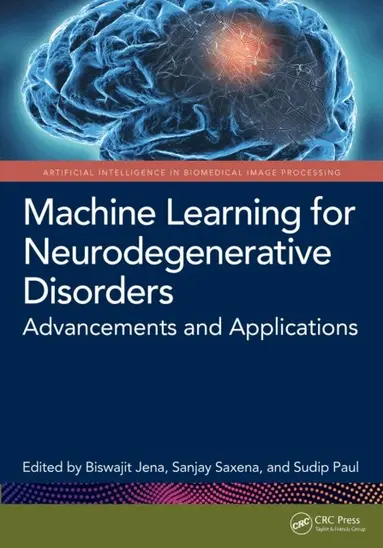
Machine Learning for Neurodegenerative Disorders
Biswajit Jena, Sanjay Saxena, Sudip Paul
Inbunden, 2025
2 232 kr
Machine Learning for Neurodegenerative Disorders
Sudip Paul, Sanjay Saxena, Biswajit Jena
E-bok
20251 030 kr
Machine Learning for Neurodegenerative Disorders
Sudip Paul, Sanjay Saxena, Biswajit Jena
E-bok
20251 052 kr
Hoppa över listan

Du kanske också är intresserad av
- -15% på allt
Machine Learning for Neurodegenerative Disorders
Sudip Paul, Sanjay Saxena, Biswajit Jena
E-bok
20251 030 kr