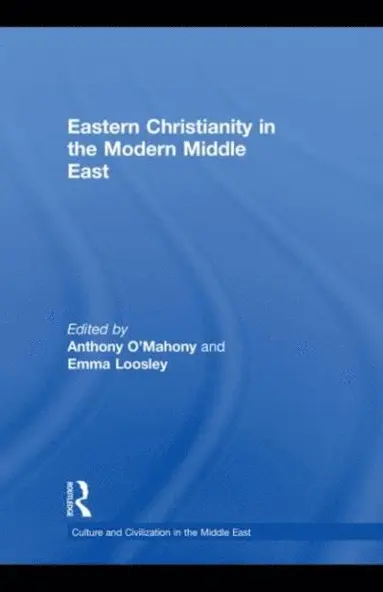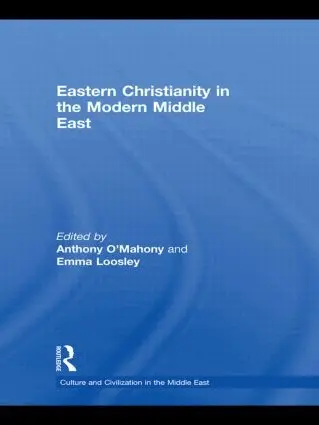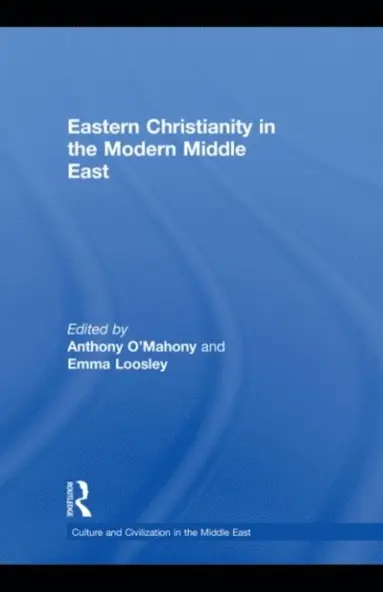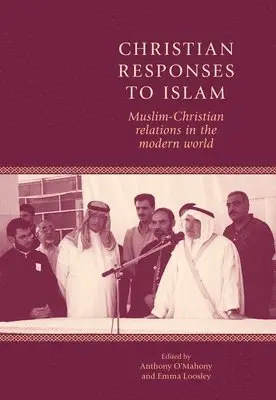
The Middle East is the birthplace of Christianity and the home to a number of Eastern Churches with millions of followers. This book provides a comprehensive survey of the various denominations in the modern Middle East and will be of interest to a wide variety of scholars and students studying theology, history and politics.
Anthony O’Mahony is Director of the Centre for Christianity and Interreligious Dialogue at Heythrop College, University of London. Emma Loosely is a lecturer and PhD supervisor in the Department of Art History and Archaeology at the University of Manchester.
Recensioner i media
"In sum, this is an excellent collection, and Loosley and O'Mahony are to be congratulated for gathering together so many fine contributors and producing such a smoothly edited, lucid, and useful collection that very much deserves a place in courses on Eastern Christianity and Middle Eastern history and culture." -- Dr. Adam DeVille, University of Saint Francis (http://easternchristianbooks.blogspot.com)
Innehållsförteckning
1. `Peter, Paul and James of Jerusalem’: The Doctrinal and Political Evolution of the Eastern and Oriental Churches Emma Loosley 2.The Syrian Orthodox Church in the Modern Middle East and Beyond Sebastian Brock 3. The Maronite Patriarchate and Church in Modern Lebanon Fiona McCallum 4. The Church of the East and the Chaldean Church in Modern Iraq and the Middle East John Healey 5. The Coptic Orthodox Church in Modern Egypt Anthony O’Mahony 6. Armenian Christianity in the Modern Middle East John Whooley 7. Eastern Orthodoxy in the Modern Middle East: The Greek Orthodox of Antioch, Alexandria and Jerusalem Sortiris Roussos 8. Between Rome and Antioch: Syrian Catholic Church in the modern Middle East Anthony O’Mahony
Betyg & recensioner
2/5
2,0 utav 5 stjärnor
2/5
Overtaken by events since it was written
The best part of the book is that it gives the earlier background to the formation of the diversity of present-day churches of the Middle East; the first chapter, "The doctrinal and political evolution of the Eastern and Oriental Churches" is a useful and concise summary which clarifies how these churches has evolved.
The remainder of the book goes into the recent history of these churches in considerable detail, to the point that readers would wish to skip over quite a lot unless they had a particular reason for this information.
Unfortunately, since the book was written in 2010, the region has been overtaken by fast-moving events, in particular, the Arab Spring, ISIS and all the political and social disruption which has occurred since and continues. Mosul and Aleppo, for example, are depicted as flourishing Christian centres.
As a result of these recent upheavals, the notion of secular states with an Arab identity is less credible than in 2010, and indeed, many Christians from the region no longer regard themselves as Arab. The book also refers repeatedly to the problems caused by Israel, but again, since the book was written there has been a reassessment of the role of Israel as a place where Christians can live safely, despite the occasional ugly incident perpetrated by ultra-orthodox Jews.
However, anyone writing on this topic would have an impossible job to keep up, with the apparent current softening of attitudes in the traditionally hard line Muslim countries possibly moving things in an altogether more favourable direction. In its present form, therefore, I cannot honestly recommend this book. It is not the authors' fault that events have worked out the way they have, but they have left the work needing to be brought up to date.