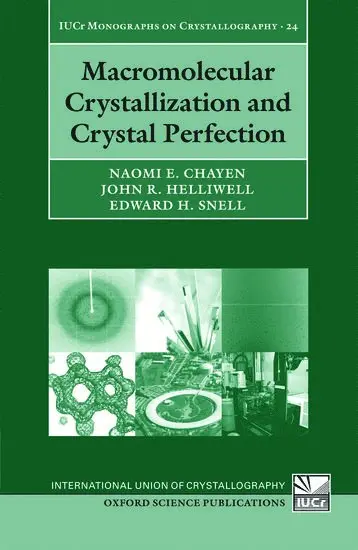
The second edition of Macromolecular Crystallization and Crystal Perfection provides an integrated practical and quantitative account of how biological macromolecules are prepared, crystallized, assessed, and matched to modern diffraction experiments. The book retains the first edition's central concern with crystal growth and order while recognizing that the ideal crystal now depends on the scientific question and the measurement method. A nanocrystal may be optimal for microelectron diffraction, a microcrystal for serial synchrotron or X-ray free-electron laser studies, and a much larger crystal for neutron diffraction.The opening sections explain sample preparation, phase behavior, nucleation, screening, optimization, seeding, and the practical recovery of projects when crystallization fails. Dedicated chapters address membrane proteins, macromolecular complexes, fragment screening, microfluidics, microgravity, and other specialized growth strategies. The book then connects crystal properties to diffraction and model quality through detailed coverage of instrumentation, Bragg and diffuse scattering, long-range order, twinning, crystalline disorder, radiation damage, cryoprotection, and post-growth manipulation.New chapters examine serial crystallography, room- and physiological-temperature measurements, Micro-ED, neutron diffraction, specialized diffraction geometries, powder diffraction, and complementary methods including cryo-EM, NMR, scattering, spectroscopy, and mass spectrometry. This edition also considers artificial intelligence and machine learning in sample design, crystallization, data analysis, and increasingly automated experiments. Written for graduate students, researchers, facility scientists, and industrial practitioners, it links the physical basis of crystallization and diffraction to the decisions required in current structural biology.