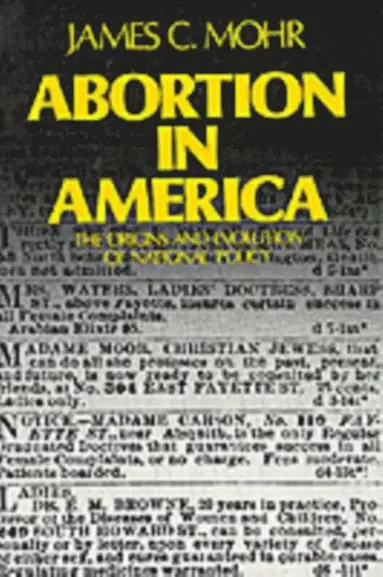
Abortion in America
The Origins and Evolution of National Policy, 1800–1900
Inbunden, Engelska, 2027
1 301 kr
Kommande. Bevaka för att få ett mejl när produkten kan beställas.
Fler format och utgåvor
Beskrivning
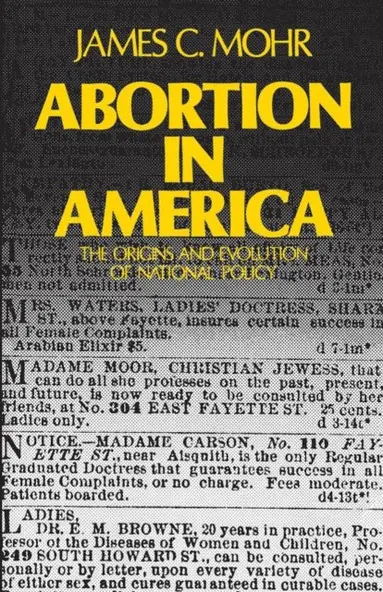
A reissue of James C. Mohr's classic and field-defining book, which has been cited repeatedly in court decisions since it was first published. A new foreword by the eminent Supreme Court scholar Linda Greenhouse reviews the dramatic legal developments that have occurred since that time. In 1800, no jurisdiction in the United States had enacted any statutes whatsoever on the subject of abortion. Courts did not regard abortion prior to “quickening” as a criminal offense, and by mid-century the practice of abortion was widespread. Abortionists advertised their services in the press and contemporaries believed that roughly one of every five or six pregnancies was being terminated. By 1900, however, every state in the nation had explicit statutes on their books that declared the performance of an abortion to be a serious criminal offense. This book examines that great shift in social policy, which took place state by state over several decades. James C. Mohr drew upon medical, legislative, judicial, private archival, and public documents to address the major questions involved in this historic shift. When did anti-abortion laws begin to appear, and for what reasons? Who pushed for anti-abortion laws? What was the response of the general public? Many of the answers presented in this book will greatly surprise twenty-first century Americans. Unlike today, for example, abortion was never a political or partisan issue during the nineteenth century and rarely discussed in any public forum. The anti-abortion push came from influential physicians, hoping to upgrade and professionalize what was then a wide-open, unlicensed, and completely unregulated medical marketplace. The statutes that those physicians persuaded state lawmakers to pass in the late nineteenth century would remain virtually unchanged through the first two thirds of the following century, even as their professional descendants pivoted to favor the liberalization of those same laws. This reissue is as timely and important now as it was when it first appeared.